Trump Issues Emergency Order That Supports Elon Musk's Next Venture (From Altimetry)
Key Points
- Bill Ackman's Pershing Square and Berkshire Hathaway both shook up their AI hyperscaler investment in a big way during Q1.
- The biggest divergence was around Alphabet, with one firm drastically lowering its stake while another more than tripled its position.
- Ackman also made a case for a huge name that has fallen out of favor: Microsoft.
- Special Report: After “33X” call, Jon Najarian reveals NEW Tesla prediction… (From Banyan Hill Publishing)
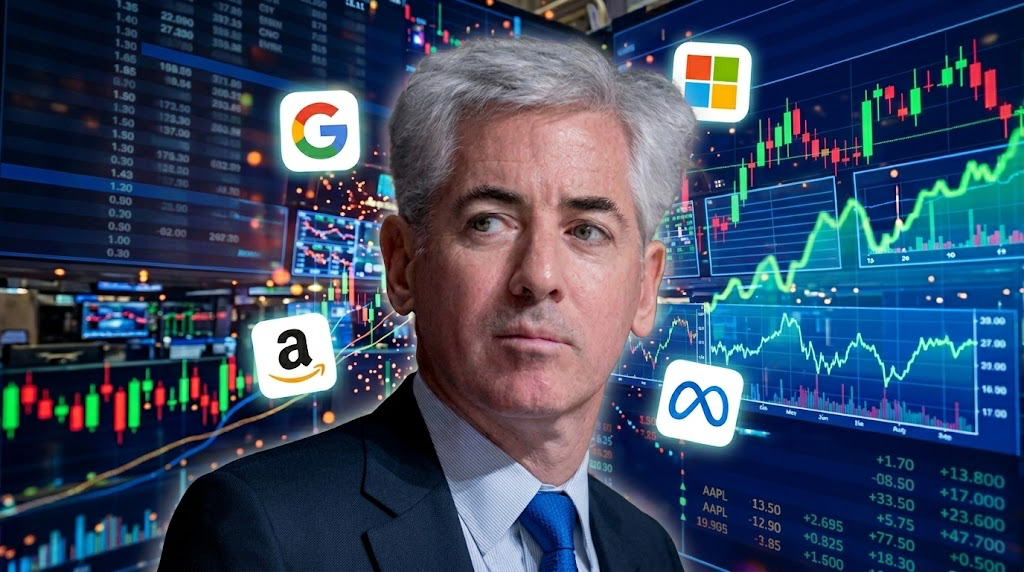
Pershing Square Capital Management (NYSE: PS), headed by Bill Ackman, has become one of the key investment funds whose moves investors watch.
Pershing is vastly smaller than Berkshire Hathaway (NYSE: BRK.B) in terms of assets. The firm ended Q1 2026 with around $13.7 billion in public equity investments, but a fraction of Berkshire’s $263 billion. Furthermore, Berkshire has around $397 billion in cash sitting on the sidelines.
However, the firms have similarities in the sense that both drive significant stock market discourse. Interestingly, these firms made several moves during Q1 2026 that were in direct opposition to one another when it comes to artificial intelligence (AI).
The #1 stock to buy BEFORE the June S-1 filing (Ad)
When the SpaceX IPO launches, most retail investors will be locked out. The banks, funds, and insiders get in early - while everyone else waits on the sidelines.
But one small infrastructure supplier - a critical piece Musk can't scale the Colossus network without - is still trading well under institutional radar. A new briefing reveals the name and ticker at no cost.
Get the SpaceX infrastructure stock name and ticker here
Pershing Drops Google Stake Massively as Berkshire Buys
One of the most interesting parts of Pershing’s Q1 2026 13F filing is the contrast in its hyperscaler investments compared to Berkshire Hathaway. Notably, Berkshire more than tripled the number of Alphabet’s (NASDAQ: GOOGL) Class A shares it held (ticker symbol GOOGL). It also bought more than $1 billion worth of Alphabet’s Class C shares (ticker symbol GOOG).
Pershing did essentially the exact opposite. It lowered its stake in both Alphabet’s Class A and Class C shares by 95%; nearly a complete exit. Overall, Alphabet represents less than 1% of Pershing's portfolio, compared to over 6% of Berkshire's. This marks a very clear divergence between two of the world’s highest-profile asset managers.
Still, it is worth noting that Pershing has been invested in Alphabet since Q1 2023, generating significant returns. Meanwhile, Berkshire joined the party much later, not investing in Alphabet until Q3 2025. Thus, Pershing participated in much more of Alphabet’s over 200% run from the end of 2022 to the end of Q1 2026. However, Berkshire’s decision is looking like a good one as of late, with Alphabet shares up more than 35% since the end of Q1 2026.
Despite selling Alphabet, Bill Ackman stated that he still has a very positive outlook on the stock.
“To be clear, our sale of $GOOG was not a bet against the company. We are very bullish long-term on Alphabet. But at current valuations and in light of our finite capital base, we used $GOOG as a source of funds for $MSFT.”
Pershing Gets in on Microsoft; Ackman Rejects Bearish Narratives
As Ackman’s post notes, the company used its funds from selling Alphabet to buy Microsoft (NASDAQ: MSFT). Notably, Microsoft was the only new holding in Pershing’s 13F. Pershing invested nearly $2.1 billion in Microsoft, making the position equal to 15.7% of the portfolio at the end of the quarter. Meanwhile, Berkshire does not have an allocation to Microsoft.
Ackman provided a lengthy explanation of Pershing’s Microsoft investment on X. In Q1, Microsoft shares fell as much as 26%. Ackman noted that Pershing believes that the recent weakness in Microsoft shares is due to two factors. First is the competitive positioning of the Microsoft 365 software suite as AI labs gain momentum. Second is the durability of growth in Microsoft’s cloud segment, Azure.
Pushing back against these narratives, Ackman said, “In our view, investors underestimate the resilience of the M365 franchise given its deeply embedded role across enterprises and highly attractive price-value proposition. Unlike point software solutions, which may be vulnerable to disintermediation by better-performing AI alternatives, M365 is tightly integrated into the daily workflow of nearly every large enterprise and is supported by Microsoft's identity, security, compliance, and data governance infrastructure, which would be nearly impossible to replicate."
In regard to Azure, Ackman said, “We believe concerns regarding Azure's growth trajectory are similarly misplaced, particularly in light of the franchise's exceptional recent performance. Azure revenue grew 39% in constant currency last quarter, with the company guiding to modest acceleration through the second half of the year."
Goldman Sachs just told you what to buy (most people missed it) (Ad)
Goldman Sachs just revealed that 40% of AI data centers will be crippled by electricity shortages by 2027 - not chips, not funding, but power. Demand is growing 15% per year and the grid can't keep up.
One small company makes the exact equipment these data centers need. They're sitting on $1.5 billion in orders, their hardware is already inside Musk's Colossus, and the stock still trades like a name nobody's heard of. Analyst Dylan Jovine is releasing the ticker for free.
See the stock positioned to solve AI's biggest power crisis
Pershing Ups Amazon Stake Significantly as Valuation Falls
The big divergences don’t end there. Pershing also increased its shares held in Amazon.com (NASDAQ: AMZN) by 19%. Meanwhile, Berkshire completely sold out of its position. Amazon is now Pershing’s second-largest holding, worth nearly $2.4 billion, representing 17.4% of the portfolio.
Valuation looks like a clear sticking point in Pershing’s decisions. Alphabet and Amazon both trade at a forward price to earnings (P/E) ratio near 30x. This is far above Alphabet’s average forward P/E over the past three years, near 23x, but far below Amazon’s average near 40x.
Meanwhile, at nearly 25x, Microsoft’s forward P/E is also well below its three-year average of around 32x.
Pershing also maintained the vast majority of its position in Meta Platforms (NASDAQ: META), dropping its shares held by less than 1%.
Similar to Microsoft, Pershing previously provided a lot of rationale for its Meta investment earlier this year.
Pershing Buys Depressed Hyperscalers, Berkshire Goes All-In on Alphabet
Ackman’s post related to Alphabet indicates that he doesn’t believe Berkshire is making the wrong decision in allocating more to the company. Rather, Pershing sees better opportunities in the market, especially in light of its smaller asset base. Pershing seems to be taking more of a “value” approach to hyperscaler investing through Amazon, Microsoft, and Meta. Meanwhile, Berkshire is doubling down on Google—a name trading near its all-time highs. This is interesting, considering that value investing is often seen as Berkshire’s M.O.
Read More
- Why Home Depot’s Sell-Off Could Become a Huge Opportunity
- These AI stocks could go to zero. Here's why. (From InvestorPlace)
- The Pentagon's AI Pivot Supercharges Defense Stocks
- You'll buy SpaceX at $1.75 trillion. Insiders bought at $20 billion. (From Behind the Markets)
- AAPL: Forget the iPhone—Services Will Drive the Next Phase of Growth
- The $132 Billion Infrastructure Pivot You Might Have Missed
- Nebius Group Pulls Back 9% After a Downgrade Despite Strong Earnings
Stay Ahead of the Market
The best investment opportunities don't wait. Get our research and stock ideas delivered straight to your smartphone—so you never miss a market-moving opportunity. Our text alerts ensure you see timely stock ideas and professional research reports instantly, whether you're in a meeting, commuting, or away from your desk.


