Editor’s Note: What if you could claim a stake in what’s set to be the biggest IPO ever… starting with just $500? Click here to see the details from former tech executive and angel investor Jeff Brown — the man who picked Bitcoin, Tesla, and Nvidia before they exploded higher. Or read more below.
Dear Reader,
Elon Musk just unlocked the biggest investment opportunity of the year.
He’s about to take SpaceX public in what’s set to be the biggest IPO ever.
The New York Times predicted it “will unleash gushers of cash for Silicon Valley and Wall Street.”
If you click here and learn what to do…
Some of that cash could end up in your pocket.
ATTENTION: There’s no need to wait for the company to go public.
You can claim your stake today.
But hurry...
Elon Musk has already interviewed the Wall Street banks that will file all the paperwork and take the company public.
And he has already announced his IPO plans to his shareholders…
Confirming that it will happen soon...
I believe he’ll file the paperwork by the end of this month…
That’s why I’m urging you to click here and learn how to claim your stake now.
Look, this might be the most anticipated IPO in the history of mankind.
Once the company goes public, for the first time ever…
Hundreds of millions of investors around the world…
Will have a chance to buy shares of one of Elon’s most successful companies.
I believe it’s going to be a stampede like we’ve never seen before.
But you can get ahead of the crowd.
Just click here and I’ll show you how to get started.
We have so much to look forward to,
Jeff Brown
Founder & CEO, Brownstone Research
VisionWave Stock: Defense-Tech Opportunity or Risky Story?
Reported by Chris Markoch. Article Posted: 4/1/2026.
Key Points
- VisionWave stock offers exposure to AI, autonomy, and defense trends but lacks a clearly defined business model.
- VWAV stock shows signs of structural selling, suggesting caution despite broader defense sector strength.
- Investors should watch for revenue growth, contract wins, and clearer execution before treating VisionWave as a long-term investment.
- Special Report: Do this before SpaceX IPOs or be sorry (From Timothy Sykes)
The defense industry is evolving toward autonomous systems and integrated missile-defense networks. That trend would seem to make an obvious case for VisionWave Holdings Inc. (NASDAQ: VWAV).
However, VisionWave has a muddled business model that warrants skepticism. The company positions itself as a proprietary technology platform with exposure to AI, sensing, autonomy, and defense applications while simultaneously leaning on acquisition-led growth.
Turn your "dead money" into $306+ monthly (starting this month) (Ad)
What if your idle cash could generate $306 or more every single month, starting now? A little-known investment strategy is making that possible with a fraction of the capital traditional advisors claim you need.
This is not a complicated play. It is a straightforward position you can open in your existing brokerage account with a single click.
Discover the financial vehicle most investors are still overlooking before the next payout hits.
Even for experienced investors, that can make VisionWave feel less like a single operating business and more like a collection of moving parts — and that distinction matters.
VisionWave is the kind of stock that attracts traders looking for the next under-the-radar multi-bagger in a crowded aerospace and defense sector.
Before diving in, investors should decide whether the company is building a durable technology moat organically or assembling one through acquisitions. In VisionWave’s case, the answer appears to be somewhere in between, which is exactly what makes the stock speculative.
A Story Built on Big Themes
On paper, VisionWave checks several boxes the market likes right now. It sits at the intersection of defense, artificial intelligence, sensing, and autonomy. The company’s messaging suggests it is developing proprietary systems to support advanced perception and mission-critical applications across air, land, sea, and space.
That sounds compelling, but broad theme exposure doesn’t automatically translate into a durable business. Many micro-cap and early-stage companies can describe themselves in the language of emerging technology. The harder part is proving the technology is differentiated, commercially useful, and scalable.
Proprietary Tech or Platform Story?
One reason investors may struggle to pin down VisionWave is that its story blends proprietary technology with growth through acquisition. Those approaches aren’t mutually exclusive, but together they create ambiguity.
A company with truly proprietary technology usually has a clear product offering, a definable customer problem, and evidence its solution is hard to replicate. A company that grows by acquisition may be buying capabilities, customer access, engineering talent, or intellectual property faster than it can build them internally. That can work, but it also raises the question of whether the company is creating value or simply stitching together assets.
This is where the bull case for VisionWave loses momentum. Is it a pure operating company, a defense software firm, a hardware-enabling platform, or a roll-up in disguise? The more layers of identity a company carries, the more cautious investors should be about assigning it a premium valuation.
The VWAV Stock Picture Urges Caution
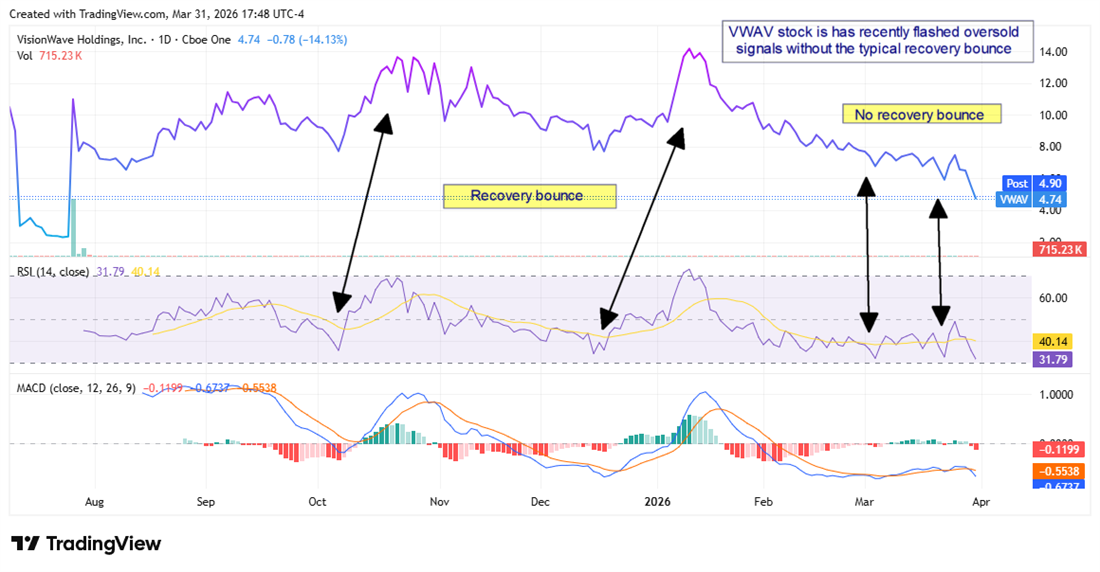
The easy take on VWAV’s chart is that it’s following other drone and defense stocks that got overbought. But a closer look reveals a pattern worth understanding.
Specifically, the stock has registered repeated RSI oversold readings without any sustained rebound, which suggests selling is structural rather than panic-driven. To be fair, some of this looks like informed distribution tied to the company’s SPAC lockup expirations — early holders are systematically exiting the stock.
That dynamic gives VWAV the attributes of a falling knife: sellers still have the motivation and inventory to push the shares lower. Until that slow grind reverses, it may be difficult for investors to capture meaningful upside.
What Investors Should Watch
VWAV has been trading for roughly nine months, which may reduce some early post-listing overhang, but it doesn’t automatically make the shares less risky. The key question is whether the business can convert its narrative into repeatable contracts, meaningful revenue, and sustainable growth.
Investors should watch for signs that the company is doing more than describing a big vision. That includes clearer revenue traction, verified customer wins, product specificity, and evidence that acquisitions are adding strategic value rather than simply increasing complexity.
It would also help to see a clearer explanation of how the company’s technologies fit together. When a business model feels blurry, it usually means the market hasn’t been given enough proof. In speculative stocks, proof matters far more than storytelling.
VisionWave may ultimately evolve into a meaningful defense‑tech platform. For now, however, it looks more like a stock built on optionality than established fundamentals. That doesn’t make it unworthy of a speculative allocation — it simply means investors should treat it as a high-risk, high-uncertainty name rather than a straightforward compounder.


