This makes me furious (From The Oxford Club)
Key Points
- The restaurant industry has become a key indicator for the K-shaped economy.
- Winners and losers are beginning to emerge based on the perceived value they offer to both higher-end and lower-end customers.
- McDonald's and Texas Roadhouse continue to grow comps despite the tough environment thanks to their value-oriented focus that keeps diners coming back.
The restaurant sector has often been at the forefront of the debate on the K-shaped economy. While consumer sentiment continues to diverge from actual consumer behavior (especially in the retail sector), the food service industry is a setting in which divergent trends become apparent quickly. While the upper end of the ‘K’ continues to indulge, more cost-conscious consumers at the bottom are searching for value to maximize their dollars.
In such an economy, two restaurants are starting to stand out, albeit for very different reasons. But the numbers speak for themselves, and McDonald’s Corp. (NYSE: MCD) and Texas Roadhouse Inc. (NASDAQ: TXRH) continue to grow comparable sales and gain market share from their competitors. Today, we’ll look at why these two have thrived in a challenging dining environment, and explain why their stocks could be set up to outperform the restaurant industry this year.
Have $500? Invest in Elon’s AI Masterplan (Ad)
What if you could claim a stake in what’s set to be the biggest IPO ever… starting with just $500?
Everyone is talking about Elon Musk’s SpaceX IPO.
Click here to get the details and I’ll show you how to claim your stake…
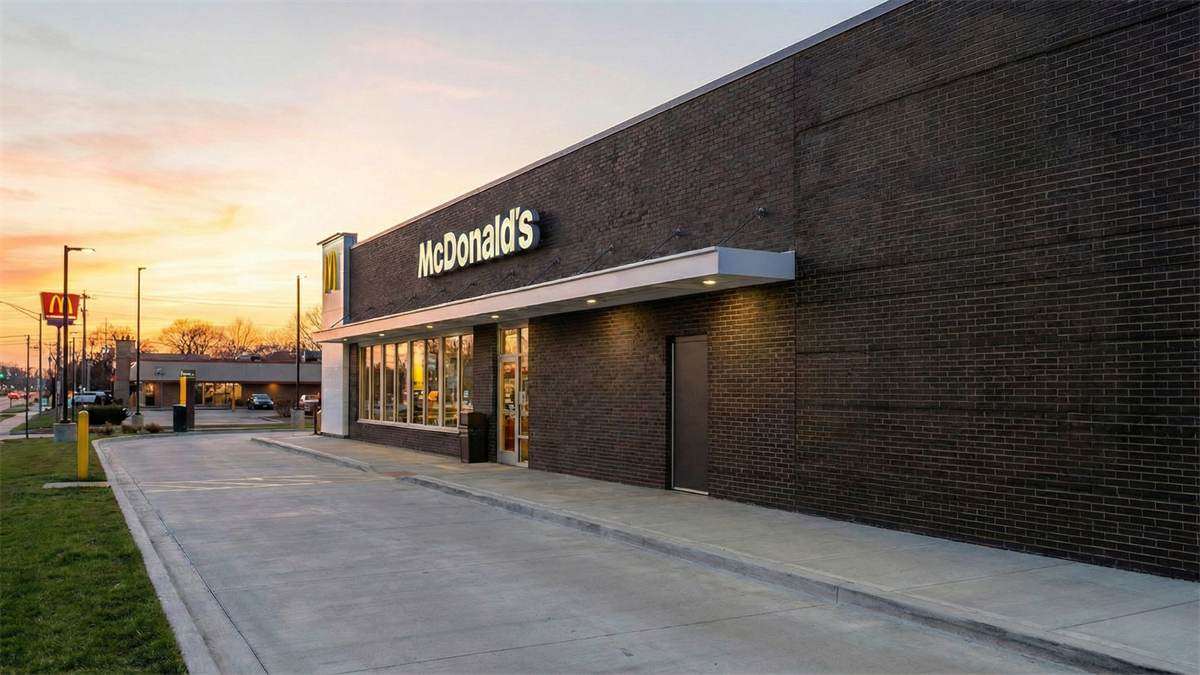
McDonald's Continues to Dominate the Fast Food Market
The earnings reports from McDonald's and Wendy’s Co. (NASDAQ: WEN) over the past week highlighted how players in the fast-food industry are separating themselves.
McDonald’s reported Q4 2025 results last week and beat on both earnings per share (EPS) and revenue projections, with 9.7% year-over-year (YOY) sales growth.
Global same-store sales smashed expectations with 5.7% YOY growth, including 6.8% growth in the United States. Now, compare these figures to the Q4 2025 report released by Wendy’s last Friday, which saw revenue decline 5.5% YOY with a same-store sales drop of 11.3% in the U.S. How has McDonald’s been able to grow sales at nearly a 7% clip in the U.S. when other Quick Service Restaurants (QSRs) struggle?
Value, value, and more value. The company projects operating margins above 40% in 2026, which enables it to pursue its Value Leadership strategy.
Unlike the limited-time value promotions run by Wendy’s and Burger King, McDonald’s Value Menu 2.0 is a permanent fixture. Extra Value Meals were reintroduced last September, and earlier this year, the company launched the McValue platform, which includes $5 Meal Deals and Buy One, Get One for $1 offers. The Grinch Meal holiday promotion drove the biggest single-day sales figure in the company’s lengthy history.
Additionally, the McDonald’s app has approximately 200 million active users, which helps drive repeat business, and the marketing focus on chicken meals, such as the McCrispy, mitigates the impact of beef price inflation. The company also plans to open an additional 2,600 stores this year, while competitors like Wendy’s are closing underperforming restaurants.
.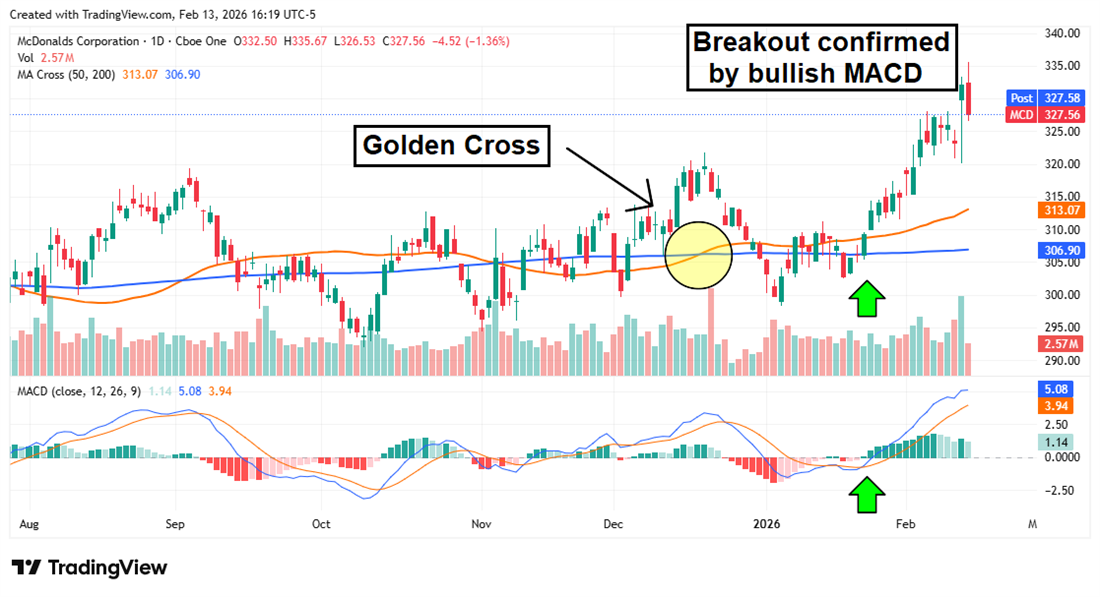
The breakout in MCD shares got started well before last week’s earnings release. A bullish crossover in the Moving Average Convergence Divergence (MACD) indicator coincided with the stock price rising above the 50-day and 200-day simple moving averages (SMAs), indicating strong upward momentum. If low-income consumers continue to trade down for value, McDonald’s is well-positioned to continue growing sales, with fundamental and technical catalysts in 2026.
Texas Roadhouse Grows Market Share Despite Commodity Headwinds
Soaring beef prices have been hanging over shares of Texas Roadhouse like a black cloud for most of the last year. Beef prices have been rising faster than inflation since the COVID-19 pandemic began, but the surge over the last two years has frightened restaurant owners and investors alike.
The price rise has been driven in part by cattle shortages, which have pushed live cow and steer prices to record levels, and this problem is likely to persist into 2027.
Despite this headwind, Texas Roadhouse continues to see same-store sales grow faster than those of its casual-dining rivals.
Texas Roadhouse’s barbell business strategy continues to offer value to cost-conscious customers while providing premium steaks and upcharge options for diners who don’t mind splurging.
In its Q3 2025 report back in November, the company reported comps of 6.1% and nearly 13% YOY revenue growth despite a 224 basis point increase in food and beverage costs. Texas Roadhouse raised prices by only 1.7% to offset these costs, a planned margin sacrifice to retain value-oriented diners.
The customer experience is a key factor in Texas Roadhouse’s success. Traffic durability is an important metric for fast-casual restaurants that depend on repeat sales. Large portion sizes, fast servers, streamlined digital kitchens, and a host of add-ons and upgrades give Texas Roadhouse the feel of a special night out without breaking the bank. Customers repeatedly report that the restaurant is “worth it” for date nights and family dinners because they know the value and experience will meet their standards.
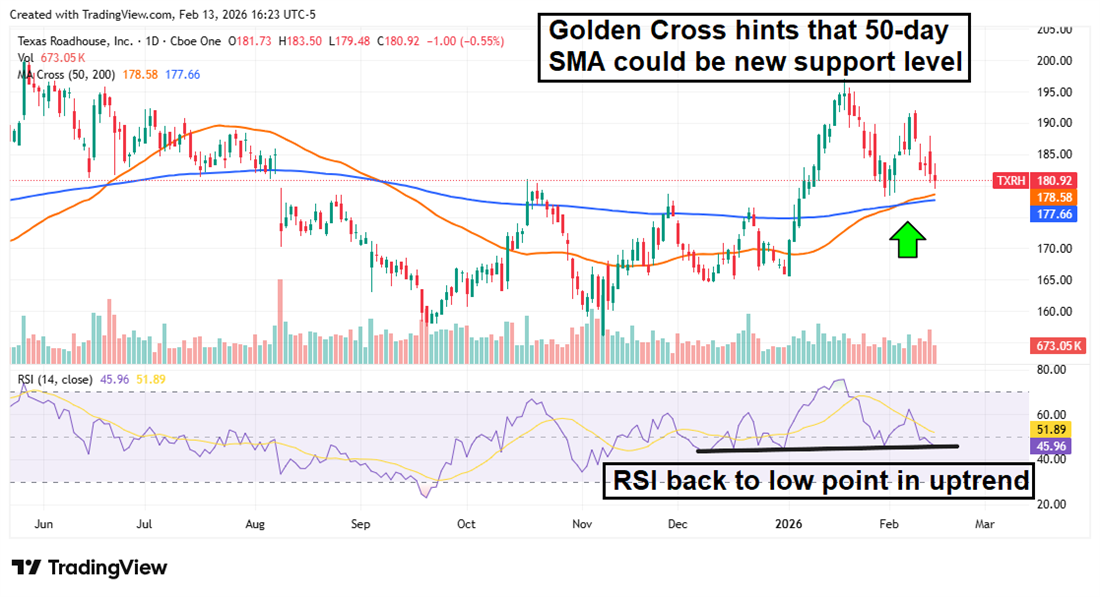
The performance of TXRH shares so far this year suggests that the doldrums of 2025 could be a thing of the past. The stock was up 11 days in a row to open 2026, bursting through the 200-day SMA barrier that had resisted previous breakout attempts. The win streak was followed by a consolidation period during which the Relative Strength Index (RSI) retreated to more neutral levels while the 50-day and 200-day SMAs converged.
Now that a Golden Cross seems imminent, the 50-day SMA could become a support level for a new rally. This area has already been tested once and held, and the share price is now approaching the 50-day moving average. This could be an opportune entry point for new investors, especially with a catalyst coming this week when the company reports its Q4 2025 results after the market closes on Feb. 19.
Further Reading
- Zillow’s 3-Day Rally Could Mean More Than You Think
- “I just bought 10,000 shares of a $5 stock…” (From The Oxford Club)
- Hims & Hers in Free Fall: Why Analysts See Nearly 150% Upside
- Trump’s Final Shocking Act Begins February 24 (From Banyan Hill Publishing)
- From Missteps to Momentum: Jack in the Box’s Comeback Plan
- 2026 Food Inflation Outlook: This ETF Could Outperform
- MarketBeat Week in Review – 02/16 - 02/20
Stay Ahead of the Market
The best investment opportunities don't wait. Get our research and stock ideas delivered straight to your smartphone—so you never miss a market-moving opportunity. Our text alerts ensure you see timely stock ideas and professional research reports instantly, whether you're in a meeting, commuting, or away from your desk.


