Don’t Buy SPCX Until You Read This (From Porter & Company)
Key Points
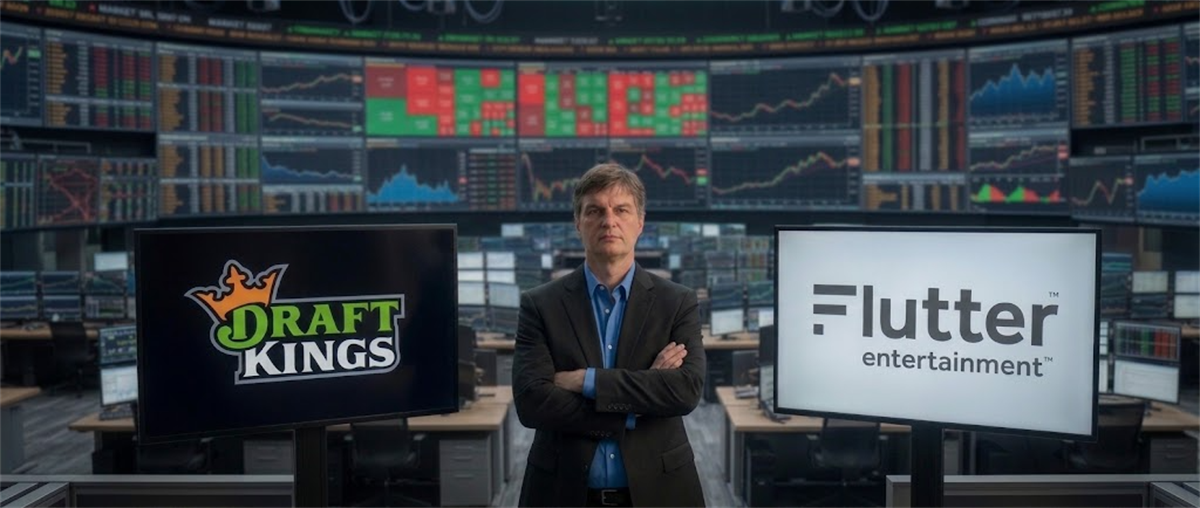
- Michael Burry recently bought shares of DraftKings and Flutter Entertainment, betting on a recovery in beaten-down sportsbook stocks.
- Burry believes prediction markets like Kalshi and Polymarket will eventually face government regulation and taxation, reducing their competitive threat to sportsbooks.
- Wall Street analysts largely agree with Burry, with consensus price targets implying 30% upside for DraftKings and 60% upside for Flutter.
- Special Report: Is the America you planned on retiring in, slipping away? (From American Hartford Gold)
Investor Michael Burry made hundreds of millions of dollars as the Great Financial Crisis unfolded by shorting subprime mortgages. This would lead to his eventual portrayal in the film “The Big Short," positioning him as a famed investor.
Burry’s hedge fund, Scion Asset Management, is now defunct. However, he remains a part of the investment zeitgeist, providing his takes on various assets.
Notably, Burry recently made his opinion known on one of the most beaten-down corners of the stock market in 2026: online sportsbook stocks.
The two most notable names in this space are DraftKings (NASDAQ: DKNG) and Flutter Entertainment (NYSE: FLUT). DraftKings operates a sportsbook app by the same name, while Flutter operates the app FanDuel.
Overall, DraftKings is down more than 20% on the year, while Flutter has lost almost half of its value. Evidently, Burry thinks the market is wrong on these entertainment names, recently picking up shares of both.
The emergence of prediction markets like Kalshi and Polymarket has been a huge driver of the decline in DraftKings and Flutter shares.
However, Burry believes that Uncle Sam will have something to say about prediction markets, significantly weakening their competitive threat.
I endorsed someone else's model for the first time (Ad)
Porter Stansberry spent 30 years ignoring outside investment systems - until he met Emmet Savage in Dublin. Savage's model, built on Hamiltonian mechanics applied to equity analysis, has delivered nearly 2,000% returns over 17 years with only one losing year.
What convinced Porter wasn't the returns. It was the sell discipline - a framework that identifies the exact moment a position's energy begins to decay, signaling an exit before the decline. He calls it the most rigorous sell system he has ever seen, comparing its edge to RenTech's famed Medallion Fund.
Watch Porter's full breakdown of Project Prophet and Emmet's system
Burry Reveals Sportsbook Purchase Prices and Weighting
Burry says he recently purchased shares of DraftKings at around $26 per share and of Flutter at around $107 per share. Shares remain very close to these levels. Burry says that his allocation between the two names is 40% DraftKings and 60% Flutter. It is notable that Burry is allocating to both stocks rather than just one. This helps limit company-specific risk, such as the potential that either company’s management team makes poor decisions that only negatively impact their firm.
Through this, Burry can bet on a general recovery in online sportsbook stocks without putting all of his eggs in one basket. However, the slight overweight to Flutter may simply reflect the fact that the stock has fallen much harder. Additionally, Flutter has shown an ability to better convert the value of the bets placed on FanDuel into actual revenue compared to DraftKings.
Burry’s Rationale: Governments Will Come for Prediction Markets
Prediction markets provide many of the same functions as online sportsbooks, allowing users to wager on the outcomes of events, including sports. Because prediction markets offer “event contracts," they are federally regulated by the U.S. Commodity Futures Trading Commission, rather than by states like sportsbooks.
In turn, they are technically legal in all 50 states, although CBS Sports notes that prediction markets are not currently live in Michigan, Minnesota, or Nevada. Meanwhile, only 30 states offer online sports betting, as many states have not legalized these platforms. Additionally, prediction markets often face significantly lower taxes than sportsbooks.
Burry ultimately believes that prediction markets will not be able to face this lower level of legal scrutiny and taxation forever. He says, “Prediction markets exist in a loophole adjacent to a heavily regulated and taxed industry. In time, prediction markets will be subsumed into regulation and taxation.”
Notably, in Q3 2021, states collected $190 million in tax revenue from sports betting nationwide. By Q2 2025, that figure had risen 382% to $917 million. With this, it is not unreasonable to think that Burry’s argument holds weight. If prediction markets take betting share from sportsbooks, states can lose out on this large and quickly growing revenue source.
He bet half his $9 billion on ONE stock (Ad)
One of the most successful fund managers of the past 50 years put more than half of his $9 billion portfolio - roughly $4.5 billion - into a single little-known company. Then his firm bought more shares for 61 straight trading days.
The former CEO of Google followed with a nine-figure partnership. The White House invoked emergency powers to protect what this company controls. A July 13th deadline could trigger a flood of institutional buying. Whitney Tilson, who called Netflix at 78 cents and Apple at 38 cents, is giving away the name and ticker free.
Watch the free presentation and get the ticker before July 13th
Wall Street Data Backs Burry’s Optimistic Outlook
Overall, only time will tell if Burry’s thesis that prediction markets will succumb to government intervention plays out. Smartly, DraftKings and Flutter are hedging for a reality where it does not. Both firms have rolled out their own prediction market offerings, potentially allowing them to benefit from growth in this space. However, Burry’s thesis becoming a reality would be ideal. Kalshi and Polymarket do not have sportsbook platforms to fall back on if regulation crushes the prediction markets industry, while DraftKings and Flutter do.
Notably, Wall Street analysts tend to agree with Burry that the market is undervaluing DraftKings and Flutter. The MarketBeat consensus price target on DraftKings is $34.30, implying upside in the range of 30%. Meanwhile, the overwhelming majority of analysts have a Buy rating on the stock. Out of 40 ratings, DraftKings has 30 Buys, eight Holds, and two Sells.
From a price target perspective, analyst bullishness is even more stark when it comes to Flutter. The MarketBeat consensus price target on this name is $178.83, implying upside in the range of 60%. However, the ratings breakdown is somewhat less favorable compared to DraftKings. Out of 29 ratings, Flutter has 18 Buys, nine Holds, and two Sells.
Further Reading
- 3 Rare-Earth ETFs That Help Investors Balance Exposure and Risk
- ALERT: Drop these 5 stocks before the market opens tomorrow! (From Weiss Ratings)
- Microsoft Bets on In-House AI to Cut OpenAI and Anthropic Costs
- Ray Dalio: Buy Gold. Get Paid. (From Investors Alley)
- Delta Air Lines Lives Up to Its Claims: Shares Can Keep Climbing
- This Dividend ETF Choice Could Shape Your Income Strategy Through 2026
- Starbucks Builds Sovereign AI to Cut $400 Million in Software Costs
Stay Ahead of the Market
The best investment opportunities don't wait. Get our research and stock ideas delivered straight to your smartphone—so you never miss a market-moving opportunity. Our text alerts ensure you see timely stock ideas and professional research reports instantly, whether you're in a meeting, commuting, or away from your desk.


