3 AI stocks to buy before August 2026 (From The Oxford Club)
Key Points
- Boxabl's public debut carries a $3.5 billion valuation as traditional homebuilders D.R. Horton and Lennar report shrinking margins, rising cancellations and unsold inventory.
- A microscopic 1.38 million-share float combined with roughly 1.2 million shares of short interest and no options market sets up conditions for an amplified short squeeze.
- More than 50,000 crowdfunding backers who rolled over equity into the SPAC deal create a looming overhang that could flood the constrained float once lock-ups expire.
- Special Report: Sell these "safe" blue chips immediately (From Chaikin Analytics)
Capital markets recently welcomed a severe threat to traditional homebuilding. Boxabl Inc. (NASDAQ: BXBL) officially listed on the public markets via a special-purpose acquisition company. Boxabl carries an eye-watering $3.5 billion implied valuation and a promise to manufacture homes in the same way we manufacture cars.
Shares rose 20% out of the gate on July 20 before retracting to the $8 range the following afternoon. However, the real story behind the IPO lies buried in the capitalization table and the macroeconomic wreckage currently surrounding legacy residential builders.
ALERT: Drop these 5 stocks before the market opens tomorrow! (Ad)
The Wall Street Journal is already raising the alarm about a potential market crash, and Weiss Ratings research points to the first half of 2026 as a particularly rough stretch for certain holdings.
Some of America's most popular stocks could take serious damage as a radical market shift plays out. Analysts at Weiss Ratings have identified five names you may want to remove from your portfolio before this unfolds.
If any of these are in your portfolio, now is the time to review your positions.
Legacy Builders Face Cracking Foundations
To understand the hefty premium the market is assigning to modular construction, you have to look at the pain traditional builders are enduring. Traditional home construction is currently navigating a paralyzing cocktail of high mortgage rates and acute labor shortages.
D.R. Horton (NYSE: DHI) just reported recent earnings, and the underlying data reveal severe cracks in the traditional site-built model. Even with an earnings beat of $3.20 per share, management explicitly lowered full-year sales guidance. They cited severe affordability challenges and cautious consumer sentiment. Pretax homebuilding margins narrowed to 12.3%, and cancellation rates spiked to an alarming 20%. D.R. Horton is now sitting on a bloated inventory of 38,000 homes, with 23,300 sitting completely unsold.
Lennar (NYSE: LEN) is also feeling this pain. The company recently posted a 31.1% year-over-year earnings decline. To move standing inventory, Lennar has been forced to offer broad price reductions, driving average sale prices down to the $375,000 to $380,000 range. The traditional lumber-yard-and-contractor model is hitting a terminal affordability ceiling. Labor costs are sticky, material costs remain elevated, and the end consumer is tapped out by current capital costs.
Assembly Lines Replace Traditional Lumber Yards
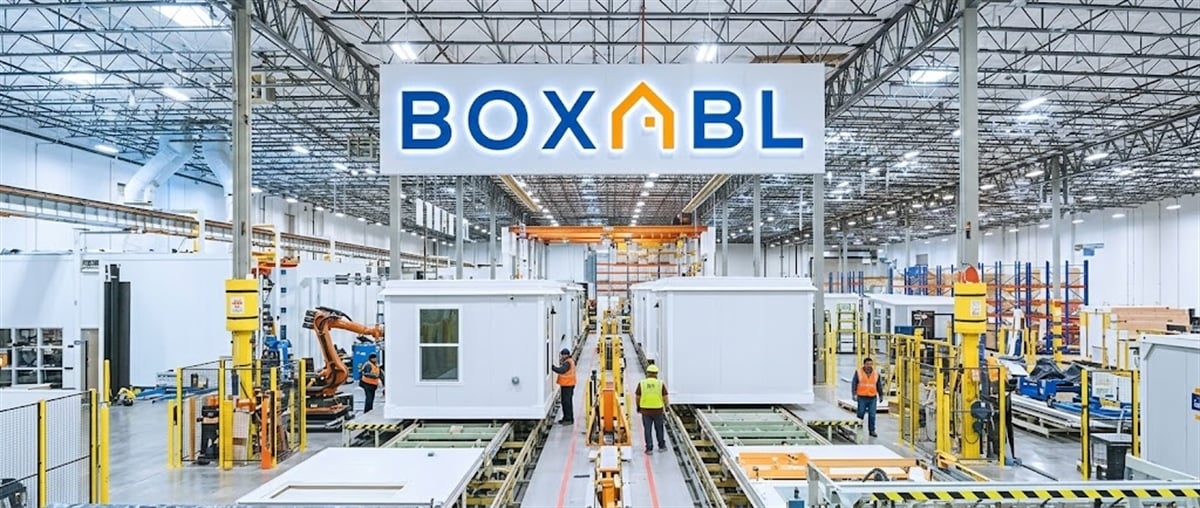
Boxabl fundamentally bypasses the localized labor bottlenecks that are currently crushing legacy players. By producing standardized modular units, most notably the $60,000, 361-square-foot Casita and the newly introduced 120-square-foot Baby Box, inside a North Las Vegas factory, Boxabl shifts residential real estate from a decentralized, weather-dependent service to a highly centralized manufacturing process.
The company's patented folding technology allows room-sized building modules to fit within standard highway dimensions for transport and then be unfolded on-site. The process fundamentally rewrites the cost structure of residential real estate, removing the unpredictability of site labor.
Boxabl recently delivered 51 units, generating trailing revenue of $3.4 million—a staggering 1,000% year-over-year revenue expansion. However, investors analyzing the company should reconcile that hyper-growth with the $3.5 billion enterprise valuation. The market is pricing in flawless manufacturing execution and immediate global scaling. The current valuation is not trading on present cash flows. Instead, investors are bidding up the stock solely on the impending disruption to a multi-trillion-dollar housing market.
Buy this stock tomorrow (Ad)
Marc Chaikin, founder of Chaikin Analytics, is flagging a little-known company that just secured a partnership with Nvidia - one he believes positions it ahead of Tesla in the autonomous vehicle race.
With a market-moving announcement expected on July 31st, Chaikin is urging investors to swap overpriced AI stocks for this under-the-radar name before markets open. He's also releasing a free Hotlist and Hitlist of buy and sell ideas for the second half of 2026.
Get the ticker symbol and full details at no charge today
Cornering the Market: A Micro Float Powder Keg
The fundamentals of the business provide the long-term thesis, but the mechanics of the float dictate the immediate price action. Heavy pre-merger SPAC redemptions near the $10.40 mark restricted the actively tradeable public float for Boxabl to a microscopic 1.38 million shares.
Here is where the setup gets incredibly volatile. Current short interest hovers near 1.2 million shares. Investors are looking at a short-to-float ratio that creates a classic, hyper-volatile squeeze setup. When a float is this constrained, any surge in buying volume forces short sellers to aggressively cover their positions by buying back shares. This forced buying creates a feedback loop that drives prices up exponentially.
Adding fuel to this fire is the current lack of a derivatives market. Options chains are currently unavailable for Boxabl. This eliminates institutional delta hedging and forces all retail speculation into pure equity accumulation.
When buyers can only accumulate common shares in a heavily shorted, low-float environment, the upside volatility becomes mathematically amplified. Retail demand is already anchored by aggressive brand visibility, most notably Elon Musk's previous use of a Casita unit near SpaceX (NASDAQ: SPCX) facilities in Texas. That halo effect has driven an extensive, verified customer waitlist, validating the total addressable market and adding immense pressure to the short sellers currently trapped in the trade.
Crowdfunded Equity Creates Structural Risks
While the upside potential is robust, navigating a recent SPAC merger requires calculated risk management. Boxabl brings a highly unusual capitalization table to the public markets. Prior to the IPO, Boxabl raised over $230 million from more than 50,000 individual retail investors via Regulation A+, Regulation D, and Regulation CF crowdfunding.
Existing Boxabl stakeholders executed a 100% equity roll-over into the newly combined entity. While this neutralizes the risk of an immediate insider exit, it guarantees a heavy capitalization overhang. When those initial lock-up periods eventually expire and early crowdfunding backers seek liquidity, the public market will have to absorb significant downward pressure. A highly constrained float of 1.38 million shares can easily be overwhelmed when previously locked shares flood the bid.
Laying the Final Bricks for a Hedged Portfolio
The transition from site-built homes to factory-manufactured housing is a required evolution to solve a systemic affordability crisis. Capital markets are finally ready to fund the industrialization of housing.
Investors looking to capitalize on this shift might consider a paired, strategic approach. Taking a cautious, speculative long position in a modular innovator like Boxabl offers exposure to the immediate short-squeeze mechanics and the long-term structural disruption of the housing market. Position sizing remains critical due to the imminent lock-up expirations and the premium price-to-sales multiple.
To balance that risk, cautious investors might pair that upside exposure with a hedged or short approach to legacy homebuilders. Companies dependent on traditional zoning and localized labor are slowly bleeding margins as they try to sell expensive inventory to a consumer base paralyzed by interest rates. Assembly lines revolutionized the automotive industry a century ago, and the same financial mechanics are coming for residential real estate.
Recommended Stories
- A Boring Dividend Growth Strategy Becomes a Solid Defensive Play
- Problems at SpaceX: time to get out? (From TradeSmith)
- Robotaxi Mode Engaged: Tesla Starts Monetizing Its Florida Fleet
- Free Stock Pick: The Company First in Line for America’s New Super Fuel (From Banyan Hill Publishing)
- Velo3D Forges a New Reality After Its Sharp Stock Sell-Off
- Why Apple Could Be the Last One Standing in the Tech Wreck
- GE Sparks a High-Voltage Aviation Breakout

Stay Ahead of the Market
The best investment opportunities don't wait. Get our research and stock ideas delivered straight to your smartphone—so you never miss a market-moving opportunity. Our text alerts ensure you see timely stock ideas and professional research reports instantly, whether you're in a meeting, commuting, or away from your desk.


