Sell 99% of Your Stocks, Do THIS Instead… (From The Oxford Club)

Key Points
- The ceasefire in Iran has sent markets around the globe soaring once again.
- International stocks in energy-starved markets are likely to get the biggest boost in the coming weeks.
- Investors turning to international markets like Germany, South Korea, and Japan could reap the highest gains.
- Special Report: Elon’s “Hidden” Company (From NXT Wave Research)
The tenuous ceasefire in Iran has the S&P 500 roaring back to life, reversing a month-long decline that put consumers and investors on edge. But the jump in U.S. stocks might have hidden the true beneficiaries: international stocks dependent on energy imports to sustain their economies. If this ceasefire leads to a resumption of normal oil flows through the Strait of Hormuz, investors can likely find outperformance in international markets. Germany, South Korea, and Japan are likely to lead the way, and here’s why.
This Elon-approved AI income stream could make you $30k-$50k a year (Ad)
During Tesla's last earnings call, Elon Musk outlined a new AI-driven approach he says could generate $30,000-$50,000 a year in passive income with minimal effort and modest upfront costs.
U.S. Senator Ted Cruz called it 'a total game-changer,' and millions of Americans are reportedly eligible to participate. This is a new business model, and early movers could be positioned for significant returns.
Watch the free presentation and learn how to get started today
Heavy Energy Import Needs Made These Nations Vulnerable
Markets across the globe (sans the energy sector) took a hit when the United States opened strikes on Iran at the end of February, but the declines were not evenly distributed. While U.S. investors felt some pain as the S&P 500 lost 10% in less than a month, markets in Europe and Asia fared worse. The European STOXX 600 index lost 12% over the same period, and the Nikkei lost nearly 15%. And then there’s the highest flying global index, South Korea’s KOSPI, which lost a stunning 25% during the conflict.
Europe and Asian markets took larger hits due to their reliance on imported energy. While the United States remains (relatively) insulated from the worst of the supply shock, European and Asian countries lack the domestic capacity to blunt massive disruptions. Countries in these regions have major industrial economies that rely on cheap energy imports, mostly from the Persian Gulf. For example, South Korea imports more than 95% of its oil, and is one of the world’s largest importers of liquified natural gas (LNG). It also operates an economy driven by the export of energy-intensive products like cars, semiconductors, and chemicals. Japan also imports more than 90% of its oil and has a similarly export-dependent economy.
Tanker traffic in the Strait of Hormuz remains stalled, but the prospects of reopening have sent stock indices in Europe and Asia soaring at the start of April. The situation remains fluid, and the ceasefire, according to the U.S. delegation, is admittedly fragile. However, optimism abounds in these energy-starved markets, and a potential normalization of traffic will have outsized benefits for the hardest-hit stocks.
If the Iran conflict is truly in its final stages, Germany, South Korea, and Japan are likely to see the biggest market upside. But instead of picking stocks, the best way to play this theme is through country-specific ETFs that provide broad market exposure.
Global X DAX Germany ETF
The Global X DAX Germany ETF (NASDAQ: DAX) is a prime choice for exposure to German stocks due to its low expense ratio and composition similar to that of the iShares MSCI Germany ETF (NYSE: EWG). DAX has just over $250 million in assets under management (AUM), which pales in comparison to EWG’s $1.38 billion. But what the fund lacks in liquidity is offset by its lower costs, as DAX’s 0.2% expense ratio is less than half that of EWG (0.5%).
DAX still trades an average of more than 60,000 shares daily, and has nearly 30% of its holdings in Germany’s industrial sector, which includes energy-hungry businesses like autos, petrochemicals, and defense contractors.
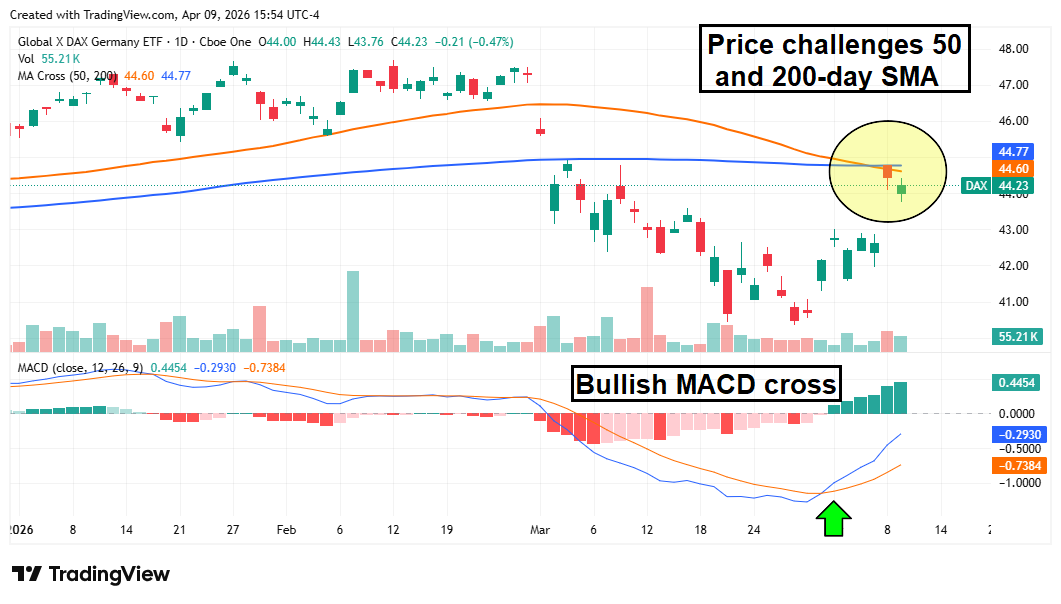
A bullish cross in the Moving Average Convergence Divergence (MACD) indicator suggested the downward momentum is about to flip, and the fund has rallied nearly 10% from its March 27 low. The 50-moving average is the next crucial level for DAX, and a sustained move above it should trigger another buying wave.
The REAL Reason Trump is Invading Iran (Ad)
For a moment…
Forget about Trump’s ties to Israel.
Forget about reports of Iran’s nuclear program.
Because my research has led me to believe we’re risking World War 3 with Iran for a completely different reason.
Click here to find out what it is.
Franklin FTSE South Korea ETF
South Korean markets are heavily tilted toward tech, thanks to the two semiconductor giants that account for more than 40% of the major cap-weighted indices.
An investment in South Korea is basically an investment in SK Hynix and Samsung Electronics Co., Ltd. (OTCMKTS: SSNLF), and the most affordable exposure comes from the Franklin FTSE South Korea ETF (NYSE: FLKR).
FLKR charges a tiny 0.09% expense ratio, which is impressively cheap for a fund offering international exposure. Tech accounts for more than 47% of holdings, with the industrial sector accounting for another 15%.
Investors couldn’t wait to jump back in the pool here, and the stock has already retaken its 50-day moving average.
The Relative Strength Index (RSI) confirmed the move by pushing back into bullish territory, and it appears the semiconductor rally is back on.
The iShares MSCI Japan ETF
The iShares MSCI Japan ETF (NYSE: EWJ) is the most expensive fund on our list (0.5% expense ratio), but its holdings are more focused on tech and industrials than those of its cheaper counterpart, the Franklin FTSE Japan ETF (NYSE: FLJP). These are the industries that would benefit most from normalized oil flow, and EWJ is likely to outperform if Iran reopens the Strait. Nearly 20% of the fund's holdings are in bank stocks, while tech accounts for 18.8% and industrials for another 16.8%. You’ll also get the liquidity of a $19.8 billion AUM fund that trades more than 10 million shares on average daily.
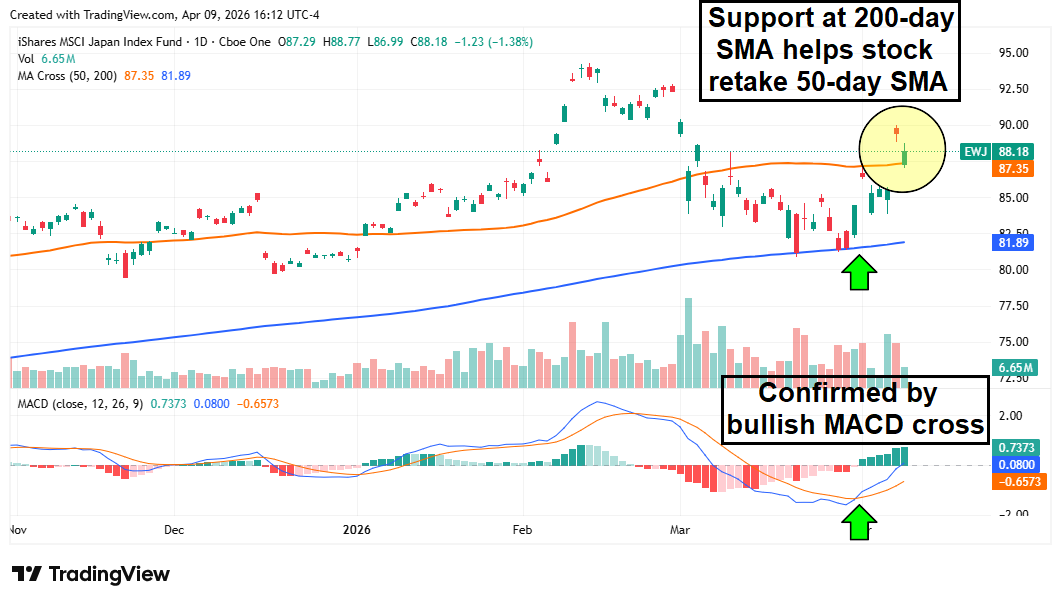
Like South Korea, technical signals indicate that bullish momentum is returning to Japanese markets. EWJ found strong support at the 200-day moving average, and a bullish MACD crossover helped propel the share price back above the 50-day MA. These are all promising signs for Japan, which has enjoyed a stock market renaissance over the last few years.
Read More
- 3 Retail Stocks to Watch for a Post-Tax-Day Bump
- Altucher: This is My Favorite FREE Starlink Pre-IPO Ticker (From Paradigm Press)
- 5 Stocks Leading the Market's Rebound: The AI Connectivity Trade
- URGENT: $2 Gold Stock With Major Discovery (From Paradigm Press)
- Insiders Sell Into Vicor Rally, Should Investors Follow Suit?
- This New ETF Aims to Capitalize on Surging AI Memory Chip Demand
- Delta's Double Miss Is a Warning for Airline Stocks
Stay Ahead of the Market
The best investment opportunities don't wait. Get our research and stock ideas delivered straight to your smartphone—so you never miss a market-moving opportunity. Our text alerts ensure you see timely stock ideas and professional research reports instantly, whether you're in a meeting, commuting, or away from your desk.


