Three oil giants buried the same discovery for 50 years (From Behind the Markets)
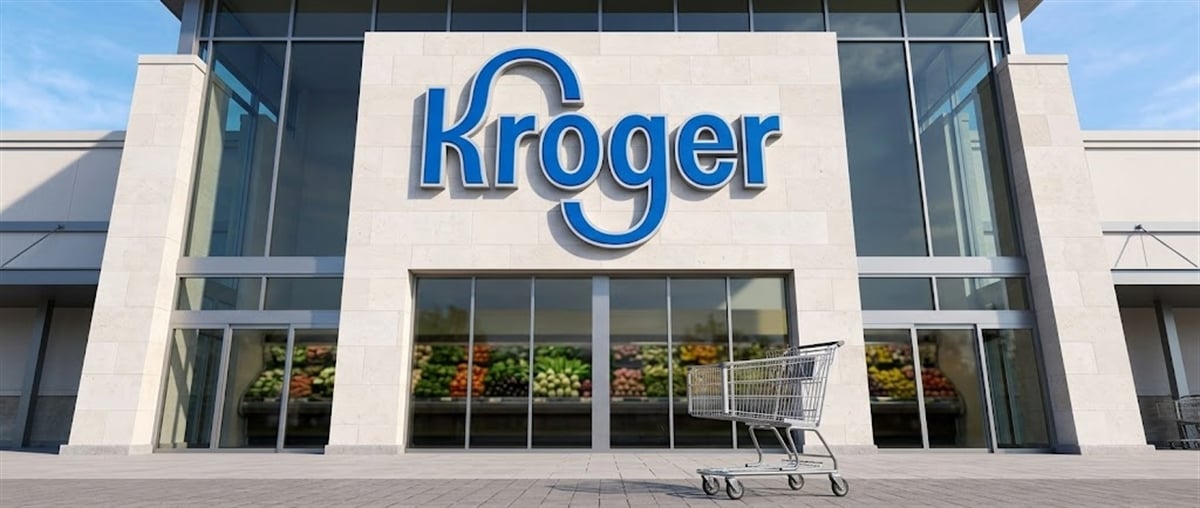
Key Points
- Kroger agreed to acquire regional grocer Giant Eagle for $1.65 billion, adding 197 stores and roughly $9 billion in annual revenue across five states.
- Following the failed Albertsons merger, Kroger's board launched a $7.5 billion share repurchase program, retiring nearly 17% of its outstanding float.
- Kroger's digital fulfillment operations turned profitable for the first time in the first quarter, strengthening the strategic rationale for integrating Giant Eagle's customer base.
- Special Report: The $15 Gold Fund That Pays Up to $1,152/Month (From Investors Alley)
The collapse of the Albertsons mega-merger forced Kroger (NYSE: KR) into a severe reckoning. Antitrust regulators effectively shut the door on transformative coast-to-coast consolidation late last year, and the market aggressively punished the uncertainty. Shares dragged toward a 52-week low of $54.15 as investors questioned how Kroger would navigate relentless pressure from omnichannel titans such as Amazon (NASDAQ: AMZN) and Walmart (NASDAQ: WMT).
Shifting consumer behavior and an unforgiving macroeconomic environment require massive scale to survive, leaving Kroger in a precarious position.
The answer arrived in the form of a definitive agreement to acquire regional grocer Giant Eagle for a total enterprise value of $1.65 billion. This transaction represents a ruthlessly pragmatic pivot in corporate strategy.
By bolting on a dense, well-established grocery network across five key midwestern and mid-Atlantic states, Kroger is securing immediate distribution leverage.
Under the guidance of recently installed Chief Executive Officer Greg Foran, who brings deep operational experience from Walmart, Kroger is orchestrating a classic value-play consolidation to defend an increasingly vulnerable economic moat.
BlackRock is hoarding it. JPMorgan is hoarding it. Do you own it? (Ad)
BlackRock, JPMorgan, Goldman Sachs, and Fidelity are reportedly accumulating a scarce blockchain asset - one that gets burned with every transaction on what analysts are calling America's new financial grid.
The Nasdaq has received SEC approval to move stocks onto blockchain rails, and BlackRock CEO Larry Fink dedicated his entire 2026 annual letter to this infrastructure shift. Blockchain analyst Andy Howard is calling this asset 'Digital Oil' - and says institutional buyers are already positioned.
Get the name, the ticker, and exactly how to buy it
Kroger Rings Up Top-Line Growth at a Bargain
Breaking down the transaction arithmetic reveals exactly why this acquisition serves as a powerful upside catalyst. Kroger is paying $1.25 billion in cash and assuming approximately $400 million in outstanding liabilities. In exchange, Kroger instantly integrates 197 supermarkets, 11 standalone pharmacies, and roughly $9 billion in annual top-line revenue across Ohio, Pennsylvania, West Virginia, Maryland, and Indiana.
Securing $9 billion in incoming revenue for a total price tag of $1.65 billion translates to a 0.18x multiple on acquired sales. Attempting to build that physical footprint organically is nearly impossible in today's elevated interest rate environment. Securing premium commercial real estate, building localized distribution centers, and acquiring net-new customers in heavily saturated regional corridors would cost substantially more capital and take a decade to execute properly.
Kroger is instead buying established cash flows and localized market dominance at a steep discount. Management expects the deal to become accretive to adjusted earnings per share (EPS) by the second full year post-integration in 2029.
Trimming the Fat: Digital Margins and Pharmacy Plays
Supermarket operators exist in an environment where profitability remains structurally tight. Kroger currently generates razor-thin net margins of 0.71% and pre-tax margins of 0.86%. Earnings per share for the first quarter of 2027 came in at $1.58, missing consensus estimates by a single penny, while identical sales excluding fuel increased by just 1.0%. Investors rightly view these metrics with caution, but analyzing the underlying operations reveals a critical inflection point hidden just beneath the surface.
During that same first quarter, Kroger's digital fulfillment operations turned profitable for the very first time. E-commerce logistics and last-mile grocery delivery traditionally bleed cash, serving as massive loss leaders to maintain market share.
Achieving sustainable profitability in digital fulfillment justifies the Giant Eagle acquisition on a fundamental level. Kroger can now seamlessly integrate Giant Eagle's established customer loyalty programs into a proven, margin-positive digital fulfillment engine, eliminating redundant logistics costs and instantly scaling online margins.
Investors must also contextualize shifting consumer behaviors, specifically the structural rise of GLP-1 weight-loss medications. Market data indicate that households using GLP-1 treatments reduce overall grocery spending by roughly 5.5% to 6.0%. This dynamic presents a widely discussed margin-pressure point for traditional center-store grocery volumes. Kroger is slightly derisked in this environment, as it already operates a massive network of in-store pharmacies.
Adding Giant Eagle's standalone and integrated pharmacy footprint acts as a natural defensive hedge. The combined entity captures high-margin prescription revenue from dispensing the weight-loss medications, effectively neutralizing the peripheral drag on traditional packaged food sales by shifting the consumer's wallet from the grocery aisle to the pharmacy counter.
The startup growing 23 times faster than Nvidia (Ad)
An official SEC document contains a name Elon Musk revealed on page 146 - a startup that one analyst believes could be the next monster IPO on Wall Street.
This company is growing 23 times faster than Nvidia. The Atlantic called it 'the fastest-growing business in the history of capitalism.' It has nothing to do with robots, self-driving cars, or rockets.
Get the name and full details, 100% free of charge
Paying the Bill: How Kroger Funds the Feast
Any debt-funded acquisition requires serious balance sheet scrutiny from investors. Kroger carries a debt-to-equity ratio of 2.43 and a quick ratio of 0.39, signaling low immediate liquidity. Adding $400 million in assumed Giant Eagle liabilities introduces near-term financial friction. When the Giant Eagle deal hit the wires, Kroger shares dipped to $53.92 amid immediate financing concerns before buyers stepped in and pushed the stock back to a close above $56
The downside risk appears heavily capped by a deeply compressed valuation and highly aggressive capital return programs. Kroger currently trades at a forward price-to-earnings ratio (P/E) of 11 and a price-to-sales ratio (P/S) of just 0.24.
These depressed metrics price in operational stagnation rather than targeted regional growth. Kroger management is aggressively exploiting the disconnect between market price and intrinsic value. Following the dissolution of the Albertsons deal, the board initiated a $7.5 billion share repurchase program. Retiring nearly 17% of the outstanding float at current depressed prices artificially boosts earnings per share. This creates a powerful dual-engine for shareholder returns when combined with Giant Eagle's incoming cash flows.
This aggressive buyback program is backstopped by heavy institutional conviction. Vanguard Group and BlackRock maintain stable equity positions, holding approximately 12.0% and 8.6% of Kroger's outstanding shares, respectively. Having over 20% of the entire float anchored by two institutional giants provides a formidable structural floor. This institutional ownership mitigates downside volatility while the regulatory and integration processes play out ahead of the 2027 closing date.
Bagging the Bottom: Why Kroger Is a Top-Shelf Buy
Capital allocation ultimately dictates long-term shareholder value in the retail sector. Kroger is leveraging a temporary weakness in its own equity pricing to acquire significant regional market share at a deep discount. Securing localized density in the Midwest and Mid-Atlantic allows Kroger to build a formidable firewall against non-traditional grocery entrants such as Walmart and Amazon.
The grocery sector rarely offers hyper-growth narratives, but the industry frequently provides mispriced cash flows. Kroger is trading at a depressed multiple while expanding its omnichannel reach, leveraging a newly profitable digital fulfillment network, and executing one of the largest buyback programs in the retail landscape.
Value-oriented investors willing to look past the immediate debt load and short-term integration friction might find current pricing levels a highly opportunistic entry point into a resilient, cash-generating retail powerhouse.
Featured Articles
- AST SpaceMobile’s Japan Catalyst Puts Its Rollout Story Back in Focus
- Sell these "safe" blue chips immediately (From Chaikin Analytics)
- Gold and Silver Recovery—3 Precious Metals Stocks for H2 2026
- Buy this stock tomorrow (From Chaikin Analytics)
- Klarna’s Google Court Win Could Give Its BNPL Story a Needed Cash Catalyst
- Why the Comcast Spin-Off Won't Fix What's Actually Broken
- Shorting the Grid: Bloom Energy’s $25B AI Power Play
Stay Ahead of the Market
The best investment opportunities don't wait. Get our research and stock ideas delivered straight to your smartphone—so you never miss a market-moving opportunity. Our text alerts ensure you see timely stock ideas and professional research reports instantly, whether you're in a meeting, commuting, or away from your desk.


