Made in America and built to power it (From Frontieras)

Key Points
- Honeywell Aerospace shares fell about 23% after its first standalone earnings report showed a 70% drop in net income and cut full-year growth guidance.
- The earnings decline was largely driven by one-time spin-off costs and financing expenses, while backlog, orders, and book-to-bill ratios all showed growth.
- Analysts maintain a consensus price target of $224.17, suggesting roughly 40% upside from current levels despite recent valuation concerns and oversold technical signals.
- Special Report: Trump’s emergency dollar reset (From Porter & Company)
In an earnings season where many companies delivered standout results, Honeywell Aerospace (NASDAQ: HONA) stood out for the wrong reasons. The company delivered its first earnings report as a stand-alone company, and the results were underwhelming.
Net income was down 70%, adjusted earnings per share (EPS) missed estimates by 20 cents, and the company cut its full-year organic growth guidance from a range of 7% to 9% to a range of just 4% to 5%.
That sent the stock down approximately 23%, continuing the downward trend that's been in place since the company was formed as a spin-off from Honeywell International (NASDAQ: HON) in June 2026.
However, this is a time when long-term investors should look beyond the headline numbers.
The company remarked that the guidance reset for the current year is being done as it prioritizes achieving its 2030 growth initiatives.
Made in America and built to power it (Ad)
America is sitting on one of the world's most abundant energy resources, but coal has been sidelined by alternative energy and rising oil costs.
Now more than 17,000 investors want to see it put back to work. And Frontieras is the company stepping in. One Frontieras investor said he wants to see the coal industry revived in the American heartland, a view many others share.
Own your piece of that shift. Don't wait:
Become a Frontieras shareholder before the opportunity closes tomorrow
A Familiar Spin-Off Playbook
The move is reminiscent of what happened with GE Aerospace (NYSE: GE), which spun off its energy and healthcare businesses into GE Vernova (NYSE: GEV) and GE Healthcare Technologies (NASDAQ: GEHC), respectively.
GE took the action to focus on its strongest growth areas and improve long‑term value for shareholders. Honeywell, a conglomeration of businesses, faces similar challenges and is attempting to unlock the same value.
One quarter is too early to draw any firm conclusions. However, the mechanics of the spin-off can't be overlooked in this quarter's numbers.
For example, the company's reported drop in net income and EPS was almost entirely due to spin-off costs and financing expenses. Specifically, a $329 million transaction plus the recognition of standalone interest expense of $200 million. When you strip those out, the miss looks far more modest and mitigates the idea that the company has a demand problem.
Demand Isn't the Issue—Output Is
If anything, the quarter reinforced that Honeywell Aerospace's problem right now is supply, not demand. Backlog grew 9% year-over-year to $18.2 billion, trailing-12-month orders were up 8%, and the company's book-to-bill ratio came in at 1.1x.
That dynamic played out unevenly across segments:
Electronic Solutions, which management says is experiencing less supply constraint than the rest of the portfolio, posted 8% organic sales growth and held adjusted EBIT roughly flat.
Control Systems grew organic sales 7% with adjusted EBIT up 12%.
Engines & Power Systems was the laggard, with organic sales up just 1% and adjusted EBIT down 24%.
The segment absorbed a mix shift toward lower-margin domestic defense and OE customers plus roughly $50 million in inventory obsolescence charges. Management cited that headwind at about 5 percentage points to EBIT growth and more than 100 basis points to margin.
That mix shift, not a falloff in orders, is the prioritization story behind the guidance cut. Management is choosing to lean into defense and international demand—where 2Q book-to-bill for Defense & Space hit 1.5x—even though that demand is less profitable in the near term.
To back that up, the company laid out a supply chain transformation plan under what it calls the HONA Operating System: doubling supplier tooling capital investment from 2025 to 2027, directing roughly 70% of that tooling spend toward constrained castings, and qualifying more than 100 new suppliers to push multi-sourced parts up over 15%.
It's a multi-year fix that could lead to some volatile quarterly earnings reports. But that's consistent with a company still finding its footing as an independent entity barely two months removed from its June 29 spin-off.
The clean coal comeback just passed $50M (Ad)
John D. Rockefeller didn't get rich pumping crude oil. He got rich refining it into gasoline and kerosene. That same potential lies in coal, and Frontieras is the company positioned to tap it.
Frontieras splits coal into diesel, jet fuel, and more without burning it, and is the only company in the world that can do it.
Now you can join over 17,000 investors already backing Frontieras.
Become a Frontieras shareholder by tomorrow, 8/27. Don't miss your opportunity.
What the Chart and the Analysts Are Saying
HONA carries a rich valuation. Too rich, say some analysts. However, there are significant nuances for investors to consider. For example, the Honeywell Aerospace analyst forecasts on MarketBeat give the stock a consensus price target of $224.17.
That's down from the $253.75 target just one month ago. But it still suggests roughly 40% upside from current levels near $160, with several analysts pointing to even higher targets.
The chart tells a similar story of overcorrection. HONA's Relative Strength Index (RSI) plunged into oversold territory in the days immediately following the earnings report. The stock has largely traded sideways in the $155–$170 range since early August.
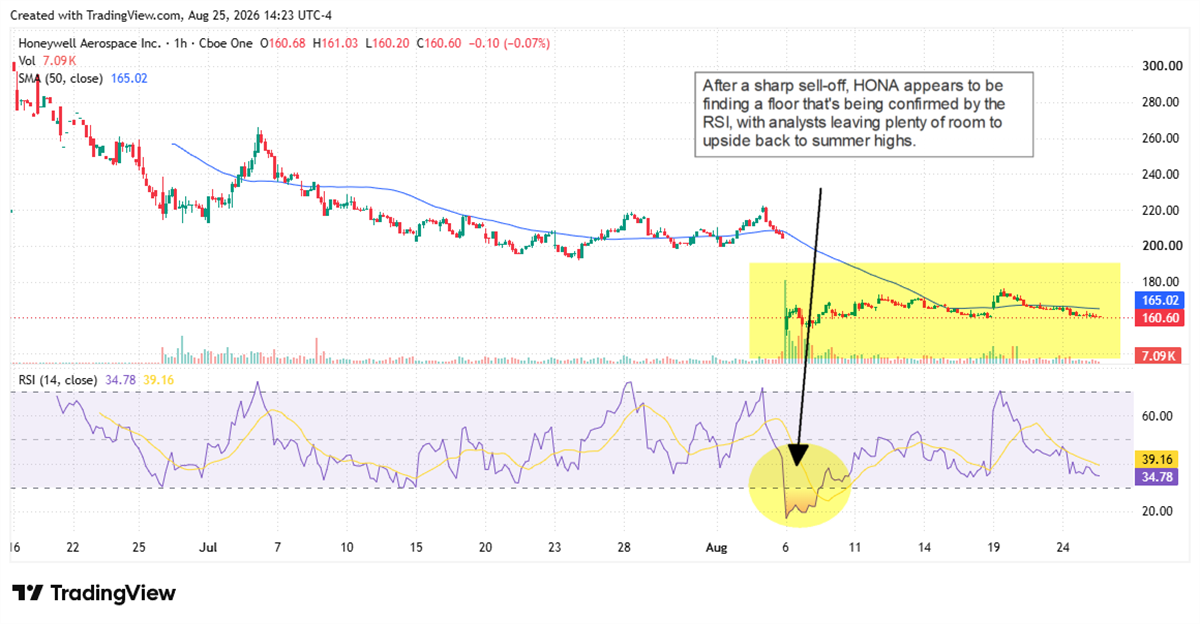
That suggests the pullback in HONA is less about value and more about the current price. That's a discrepancy that investors can take advantage of.
HONA triggered an oversold signal immediately after its earnings report, and it's approaching that level again. However, based on the company's current fundamentals—a growing backlog, a credible plan to unlock output, and a deliberate near-term trade-off in favor of 2030 targets—that seems like the right place for investors to start a position rather than abandon one.
Featured Articles
- Photronics Is Quietly Becoming a Key Winner From the AI Boom
- This Gold Explorer Sits Right Next to Barrick's Nevada Mines (From Wall Street Logic)
- Looking Beyond NVIDIA? These 3 AI ETFs Are Beating the Market
- ALERT: Drop these 5 stocks before the market opens tomorrow! (From Weiss Ratings)
- Palantir's Kool-Aid Moment: The Math Behind Karp's Forecast
- OpenAI’s Jalapeño Chip Could Change the AI Hardware Race
- Gold and Bitcoin Are Rebounding—2 ETFs Give Investors a Different Kind of Exposure

Stay Ahead of the Market
The best investment opportunities don't wait. Get our research and stock ideas delivered straight to your smartphone—so you never miss a market-moving opportunity. Our text alerts ensure you see timely stock ideas and professional research reports instantly, whether you're in a meeting, commuting, or away from your desk.


