Get this “Fed ticker” before September 16 (From Brownstone Research)
Key Points
- Analyst consensus rates Micron stock a Buy with 92% bullish bias, forecasting upside toward $1,295 and potentially $2,000 per share.
- Micron's chart technicals point to a $1,600 to $2,400 price target range, supported by a strong rally and MACD convergence signals.
- Persistent high-bandwidth memory demand, sold-out capacity through 2027, and over $100 billion in orders suggest tightness will continue for years.
- Special Report: Small Colorado Company (Backed by Sam Altman) Could Save U.S. Power Grid (From Altimetry)
Signals from chart price action to analysts' sentiment point to another massive run for Micron (NASDAQ: MU) stock. While headwinds and hurdles such as market angst, profit-taking, and repositioning weigh on price action today, long-term trends suggest at least another 100% upside. The hurdle in September is the broad call to slow down AI’s advancement.
Is This the New Normal for Gold? (Ad)
Barrick Mining has spent decades building one of the world's great gold districts in Nevada, anchored by Fourmile, Goldrush, and Cortez Hills, a region that could hold as much as 60 million ounces of gold.
Bordering Fourmile and less than a mile from Goldrush sits a little-known explorer now moving from historical data toward active exploration, setting targets and preparing for a maiden drilling program.
With gold trading near record highs, this could be a pivotal stage for an overlooked name in the district.
See why this overlooked gold explorer could be entering its most important stage
Micron Is Well-Positioned for AI’s Virtuous Cycle
The news reads as a red flag, but it's also a red herring—the alarm over runaway models obscures who actually stands to gain when AI's advance stalls.
As scary as the advancement of uncontrollable models may be, it’s not the models that AI companies are worried about. In this scenario, slowing AI’s advancement—cough cough, pausing training of the most expensive models—is what the market needs, as it would reduce the high upfront costs of AI, enabling hyperscalers to monetize the infrastructure in place, improve cash flow, and reassure investors while affirming an ability to continue the spend. Regarding regulation, as MarketBeat writer Chris Markoch likes to put it, what more could AI companies ask for than the government installing roadblocks for startups and widening their moat?
For Micron, this means continued, persistent demand for its high-bandwidth memory (HBM) products. The biggest risk is an anticipated earnings cliff tied to capacity expansion and price normalization. Memory chip stocks command premium pricing in 2026, which is a central factor in Micron’s results and earnings outlook.
The market gets this wrong: this isn’t a legacy-style memory cycle in which demand spikes, peaks, and retreats, undermining pricing power, but the early stages of a long-running trend in which datacenter demand and inference keep prices elevated. The worry is that efficiency gains reduce how much memory each query needs. But efficiency isn't the memory killer. Rather, efficiency makes inference more affordable, and affordability drives demand, increasing queries and the need for memory.
Micron Winds Up for Big Move, Technicals Point to $1,600-$2,400 Range
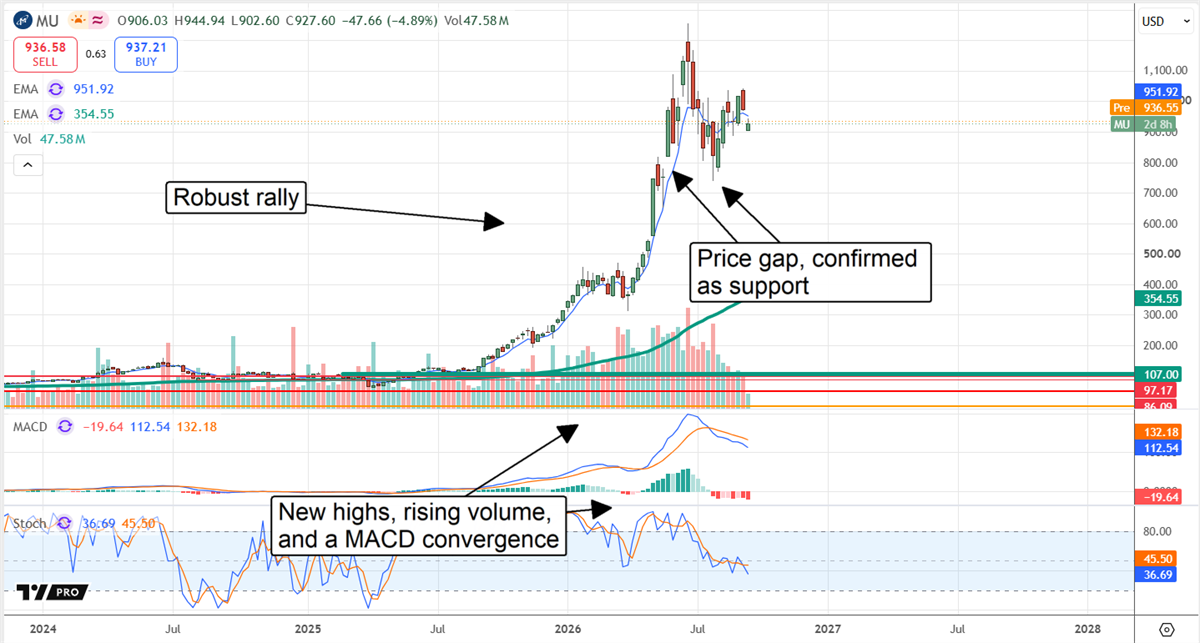
Micron’s chart price action is very bullish. The market has rallied strongly over the trailing 12 months, rising almost $800, or 500%, and it also crossed an inflection point, creating a price gap later confirmed as support.
The weekly chart shows a robust rally and consolidation range, likely signaling continuation. The critical details are the magnitudes of the range and rally, which approach $400 and $800. These are the projections for future price action, assuming a fresh high is set, putting the technical price targets at $1,600 and $2,400.
Among the more bullish technical factors is the MACD convergence. MACD convergence signals a strengthening market that is likely to retest existing highs and move on to new ones. The technical risk is that price will top out near the existing highs, but earnings and analyst trends suggest otherwise.
Micron’s analyst trends are as bullish as they’ve been for the last two years. MarketBeat’s data reveals steady, firm coverage with 38 analysts showing strong conviction. They rate MU with a consensus of Buy, with 92% Buy-side bias, and the price target trend is upward. Consensus forecasts a move to $1,295, a 40% upside as of mid-September, sufficient to set a fresh high. More importantly, the trend leads to a consensus-or-better price point, with the high end at $2,000, more than 100% upside and within the technical targets.
A US Gold Explorer Approaches a Key Drilling Milestone (Ad)
A little-known Arizona gold explorer just hit 66.2 metres grading 6.57 g/t gold, including 20.7 metres at 18.25 g/t.
After roughly 21,000 metres of drilling, the company is closing in on its first-ever mineral resource estimate, expected in Q3 or Q4 2026.
That estimate could offer the market its first real look at the scale of this emerging gold system.
See what could be next for this US gold explorer
Capacity Constraints to Continue: HBM Prices Aren’t Going to Fall Soon
The catalyst for MU stock is capacity constraints. The market focuses on expansion plans but fails to understand that capacity increases aren’t expected to significantly impact supply until at least late next year, and that market tightness is likely to linger through 2028 or longer. More aggressive forecasts suggest that market tightness will persist into 2031, and there are numerous reasons to believe them.
Not only is the DRAM market neglecting its legacy business and building shortfalls in non-AI markets, but system-wide HBM demand will only increase. Advanced Micro Devices (NASDAQ: AMD) isn’t using MU for its MI-450’s but does use HBM, more than NVIDIA (NASDAQ: NVDA), in fact, and its sales are expected to explode over the subsequent few quarters, keeping HBM supplies tight.
If investors need further proof, they need only look at Micron’s backlog and commitments. As it stands, the company has over $100 billion in logged orders, capacity is sold out through 2027, and it will likely sell out through the end of 2028 soon. Commitments include 16 major long-term supply contracts with set pricing, providing visibility. In the words of CEO Sanjay Mehrotra, demand exceeds capacity by approximately 50%. In this environment, there is no reason to think the HBM market will crash anytime soon. Acceleration is more likely.
Featured Articles
- Enterprise AI to Boost Broadcom's Software Business? What Industry Data Shows
- Trump goes "all-in" on Grand Canyon energy breakthrough (From Behind the Markets)
- IonQ and NVIDIA Just Cracked a Major Quantum Computing Bottleneck
- Here’s the stock symbol I’ve promised (From Stansberry Research)
- This Gold ETF Turns a Non-Yielding Asset Into Monthly Income—But There’s a Catch
- Analysts See Double-Digit Upside for These 3 Stocks
- 3 Luxury Consumer Brands to Watch in a Beaten-Down Sector

Stay Ahead of the Market
The best investment opportunities don't wait. Get our research and stock ideas delivered straight to your smartphone—so you never miss a market-moving opportunity. Our text alerts ensure you see timely stock ideas and professional research reports instantly, whether you're in a meeting, commuting, or away from your desk.


