The $100 Stock Behind Elon's Next Move (From Paradigm Press)
Key Points
- ServisFirst Bancshares posted strong second-quarter results, with net income up 39.7% year-over-year and an expanding net interest margin.
- Analysts hold a consensus Buy rating on the stock, with an average price target of $47.67 suggesting roughly 16% upside.
- Rising nonperforming loans and heavy geographic concentration in Alabama and Florida pose risks despite the bank's efficient, high-return operating model.
- Special Report: The REAL Reason Trump is Invading Iran (From Banyan Hill Publishing)
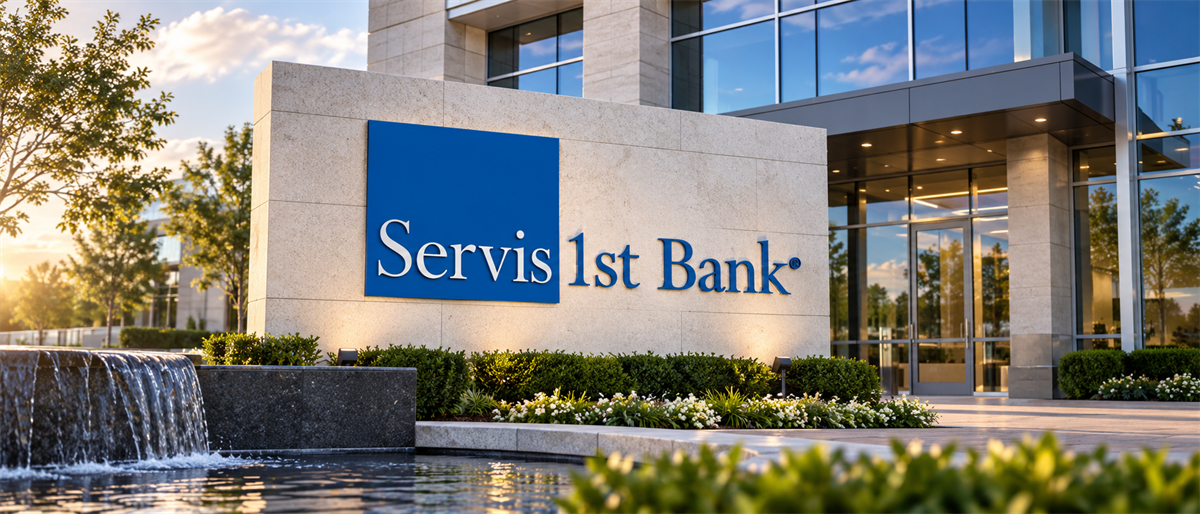
ServisFirst Bancshares (NYSE: SFBS) has spent two decades building a reputation as one of the leanest, fastest-growing business banks in the Southeast.
That reputation seems to be paying off as analysts rate the regional bank a Buy.
A stock split, a set of high-profile index additions, and some of the strongest quarterly numbers the bank has posted in years arrived even as the broader regional-bank group wobbled under the weight of rising Treasury yields.
With analysts placing a decent 12-month upside on the stock and the prospect of higher rates on the horizon, ServisFirst’s operating momentum is worth the attention of bank-sector investors.
Here’s Why Trump Won’t End The Iran War (Ad)
Trump has called an Iran deal close 38 times since the war began, yet the fighting keeps flaring back up.
One day it's a ceasefire, the next it's bombs again. The back and forth may be masking a bigger story most investors are missing.
See the real reason this conflict may never fully end.
Uncover the real reason Trump may never end this war
Stock Split and Index Additions Boost Visibility
The shareholder event of the year came on July 20, when the board declared a two-for-one stock split in the form of a stock dividend, with post-split trading beginning Aug. 21. It was a move management framed as an effort to broaden the shareholder base and improve trading liquidity.
Around the same time, index provider FTSE Russell added the stock to the Russell 2000 Value, Russell 2500 Value, Russell 3000 Value and related value benchmarks in its June 2026 reconstitution, a move that typically brings in new institutional buyers tracking those funds.
Earnings Show Strong Momentum
Underneath the corporate action, the actual banking business had a strong second quarter.
Net income for the quarter rose 39.7% year-over-year to $85.8 million, with diluted earnings per share of 79 cents per share, or $1.57 on a pre-split basis, up 40.2% from $1.12 a year earlier.
Net interest income climbed 18% to $155.6 million. The net interest margin expanded to 3.63%, up 53 basis points from a year ago.
Loan growth stayed brisk as well, with total loans up $533 million, or 15% annualized in the second quarter to $14.48 billion, funded by deposits that grew 5% to $14.55 billion.
Profitability metrics also stand out for a bank this size. The company’s efficiency ratio was just 29.65%, down from 33.46% a year ago, annualized return on average assets of 1.91%, and return on common equity of 17.71%.
Those results build on a strong full-year 2025, in which both net income and earnings per share climbed sharply from the year before.
President Trump’s new AI tirade hurting GOP? (Ad)
President Trump says AI regulation will not stop what he calls the greatest economic engine in history, bigger than oil, gold, diamonds, or the internet. Meanwhile, The New Republic reports Republicans are eager to rein in AI ahead of the midterms.
Whitney Tilson, the analyst CNBC once called The Prophet for calling the dot-com crash, the Bear Stearns and Lehman collapses, and the 2009 market bottom, says a new divide begins in 100 days with major implications for portfolios.
Tilson lays out what he believes could separate winning and losing portfolios over the next six months.
Watch Whitney Tilson's urgent briefing and prepare your portfolio now
Growth and Efficiency Strengthen the Bull Case
That combination of double-digit loan growth, expanding margins and a sub-30% efficiency ratio is the core of the bull case.
ServisFirst runs a low-overhead, relationship-banking model that avoids the branch bloat of bigger regional peers. It has been methodically extending that formula beyond Alabama into Florida, Georgia, Tennessee, and the Carolinas, opening a new office in Panama City, Florida, in May and now operating 35 full-service banking locations across eight states.
The bank was also recently ranked sixth nationally among banks with $10 billion to $50 billion in assets for overall performance, and that kind of organic expansion, funded without heavy reliance on brokered deposits or Federal Home Loan Bank advances, is an interesting differentiator for investors hunting growth in the banking sector.
Share Gains Raise Valuation Questions
Much of that growth has already occurred. Although the company’s stock is up just 3% over the past three months, it has increased 15% since the start of the year. It hit a 52-week high of $46.04 in mid-August.
For income investors, the board also raised the quarterly dividend 13.4% in December 2025, and on a post-split basis the stock now pays 19 cents per share quarterly. The resulting yield of about 1.8% is modest, but a 10-year streak of consecutive increases and a conservative payout ratio of about 26% suggest room for further hikes.
Analysts See More Upside Ahead
Wall Street analysts are generally impressed. With a consensus rating of Buy, one analyst covering the stock has ServisFirst with a Strong Buy, three suggest Buy, and one recommends Hold.
The stock carries a 12-month average price target of $47.67, or roughly a 16% upside. With the highest price target at $48.50 and the lowest at $47, there appears to be little disagreement about the company’s future prospects.
Credit Quality and Concentration Pose Risks
Still, some skepticism is warranted before chasing this one.
Credit quality deserves a watchful eye. Nonperforming loans more than doubled to $171 million compared with a year ago, and the allowance for credit losses rose nearly $8 million to $181.9 million over just the past three months, a reminder that rapid loan growth in commercial real estate and business lending carries risk. The company said that one large real-estate secured relationship led to the second-quarter increase in nonperforming assets.
Geographic concentration is another factor. Nearly all of ServisFirst's loan book sits in Alabama, Florida and a handful of neighboring states, leaving it more exposed than diversified peers such as Pinnacle Financial Partners (NYSE: PNFP), SouthState (NYSE: SSB) and Ameris Bancorp (NYSE: ABCB) to a regional downturn.
ServisFirst Needs to Sustain Its Momentum
Even with the risks in mind, ServisFirst looks like a well-run, high-return regional bank.
The split and index inclusions are more about liquidity and visibility than fundamentals, but the underlying growth in loans, deposits, and net interest margin is real and difficult for larger, slower-moving peers to replicate.
For patient investors comfortable with regional-bank volatility and rate sensitivity, the current pullback from 52-week highs could offer an attractive entry point.
Yet, with an unknown future of Fed action and yields, and the bank’s regional concentration, investors might want to keep watch as this growth-oriented regional bank still needs to prove it can sustain momentum through a full interest-rate cycle.
Further Reading
- J.B. Hunt's Stock Plunges After Market Misprices Profit Warning
- Trump goes "all-in" on Grand Canyon energy breakthrough (From Behind the Markets)
- 2 Stocks Breaking Out Post-FOMC With One Thing in Common
- The energy story near the Grand Canyon (From Behind the Markets)
- Lennar's Q3 Miss Hides a Stronger Operating Story Beneath the Housing Slump
- These 3 Stocks Are Drawing Insider Buyers for Very Different Reasons
- Braze Beat Expectations—Now 2 SaaS Peers Are in Focus

Stay Ahead of the Market
The best investment opportunities don't wait. Get our research and stock ideas delivered straight to your smartphone—so you never miss a market-moving opportunity. Our text alerts ensure you see timely stock ideas and professional research reports instantly, whether you're in a meeting, commuting, or away from your desk.


