Small Colorado Company (Backed by Sam Altman) Could Save U.S. Power Grid (From Altimetry)
Key Points
- NVIDIA reports Q2 fiscal year 2027 results on Wednesday, with investors focused heavily on guidance and what it signals about continued AI infrastructure demand.
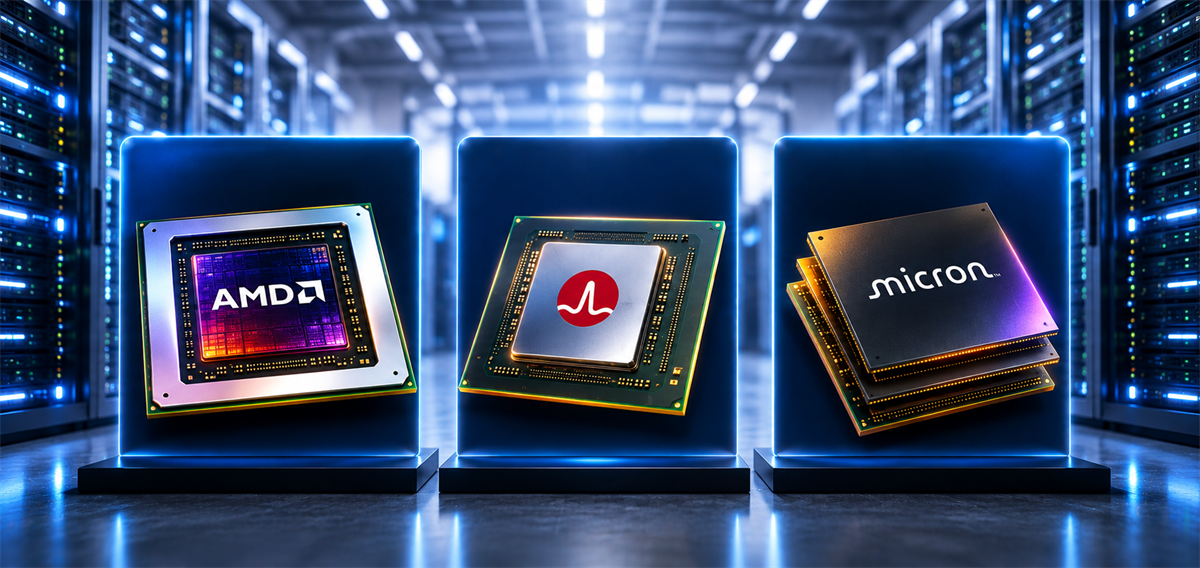
- AMD, Broadcom, and Micron each have significant exposure to the AI buildout, but NVIDIA’s results could affect each company for different reasons.
- AMD faces direct competition in accelerated computing; Broadcom is exposed through custom AI silicon and networking; and Micron is closely tied to NVIDIA’s Vera Rubin platform through HBM4.
- Special Report: The Musk-linked sector everyone's sleeping on (From Brownstone Research)
Imagine if the Super Bowl were held four times a year instead of once? That’s often how it feels covering earnings day for NVIDIA Corp (NASDAQ: NVDA), where the entire market stops to watch one company’s numbers and conference call. NVIDIA’s pull in the AI trade is so powerful that it often affects other companies in the semiconductor ecosystem, especially when revenue guidance comes in above expectations.
The next anticipated report comes Wednesday when NVIDIA releases its Q2 fiscal year 2027 results, with the market expecting revenue of $92 billion at the top end and earnings per share (EPS) of $2.09. But as always, the real catalyst will be guidance, the market’s most reliable data point on hyperscaler spending. A guide above expectations means that spending is still accelerating, while inline or (gasp) below expectations would hint that the buildout is running on hype over substance.
This under $1 stock could become Musk's next supplier (Ad)
A little-known company trading under $1 could become Elon Musk's next supplier, with a possible announcement expected by Wednesday, August 26.
Tech investing veteran Jeff Brown notes that the last time Musk struck a deal with a small company in this sector, the stock soared nearly five times in a single session. He has reopened his strategy session with full details on this potential opportunity.
Watch Jeff Brown's urgent strategy session before the Wednesday deadline
Larry Benedict's Top Ticker Watch Before the Fed's September 16 Decision (Ad)
Barron's ranked Larry Benedict's former hedge fund among the top 1% in the world. He went 20 straight years without a losing year and generated $274 million for his clients.
Now Benedict is watching one ticker he believes could move as Trump's Fed announces its next interest-rate decision on September 16. Past Fed announcements have offered his readers moves of 117% in under a month and 89% in 17 days.
See the ticker Larry Benedict is watching before September 16
3 AI Stocks That Could Feel NVIDIA’s Earnings Aftershock
The AI trade is vast and extends into many different industries and fields of expertise. Three of the biggest players are Advanced Micro Devices Inc. (NASDAQ: AMD), Broadcom Inc. (NASDAQ: AVGO), and Micron Technology Inc. (NASDAQ: MU), each representing a different leg of the AI infrastructure buildout. And each of these three companies is closely tied to NVDA’s reports, even if they compete for customers in certain industries.
AMD: Proxy for Demand or Proxy for Share?
The second half of 2026 should be a big one for AMD thanks to the Helios ramp-up. Helios racks are a direct competitor to NVIDIA’s Vera Rubin, and the company has already secured major commitments with Anthropic for 2 gigawatts (GW) of compute, plus deals with Meta Platforms Inc. (NASDAQ: META) and OpenAI.
What does NVDA’s guidance tell us about AMD? The answer is clues on the size of the actual market. If NVDA guides above expectations, it validates the total addressable spend from these ever-growing commitments. If NVDA gives lackluster guidance, it could signal the pie is shrinking. More importantly, if NVIDIA management expects Rubin to grow its market share, that’s likely at Helios’ expense and puts AMD in a position where its Q3 execution must be flawless.
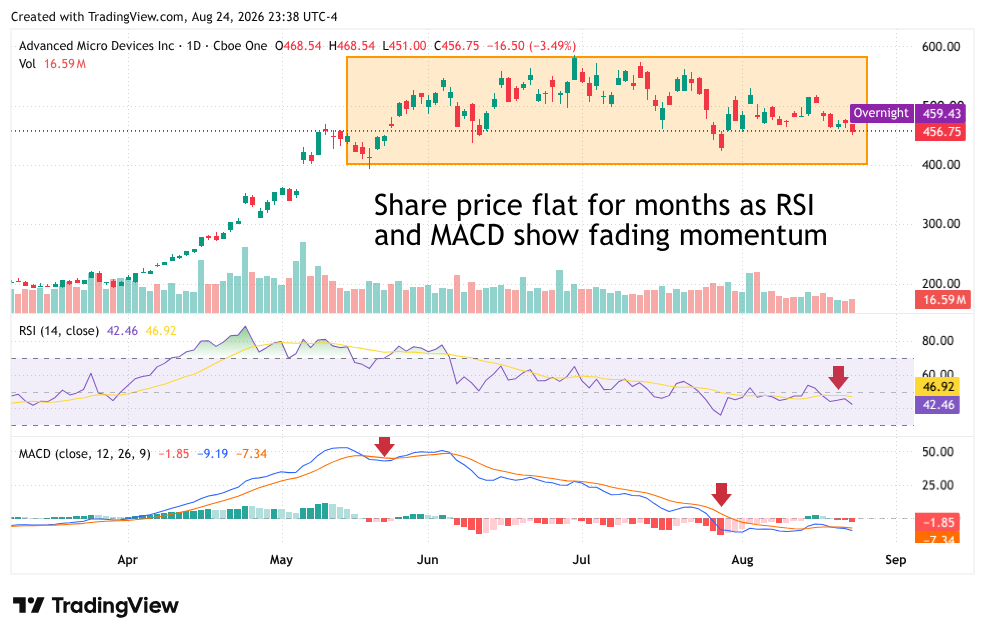
Despite a year-to-date (YTD) gain of more than 100%, it's been a rough summer for AMD shareholders. Most of the gains came before May, and the stock is stuck in a tight trading range. Even more concerning is the evaporation of momentum, evident in the Relative Strength Index (RSI) and Moving Average Convergence Divergence (MACD) indicators. Investors should watch whether AMD trades with NVDA or against it in the Thursday and Friday sessions after the release to see how the market frames it.
Broadcom: The Highest Bar to Clear
Custom silicon and networking tools are crucial data center components, and Broadcom is one of the world’s largest developers. But expectations are exceedingly high, and the stock now trades at nearly 60 times earnings and 27 times sales. The reaction following the company’s Q2 2026 earnings report highlights these heightened expectations. Broadcom beat EPS and revenue estimates on June 3, with record quarterly revenue of $22.2 billion and operating margins of 67%.
Despite this massive beat, management maintained its fiscal full-year 2027 AI revenue target of $100 billion, and the stock promptly sold off 15% the following day. The market expects acceleration, and AI networking represented nearly 40% of Broadcom’s fiscal Q2 revenue. If NVDA’s guidance fails to impress, or if commentary on networking buildout is less than optimistic, it could spell more trouble for Broadcom.
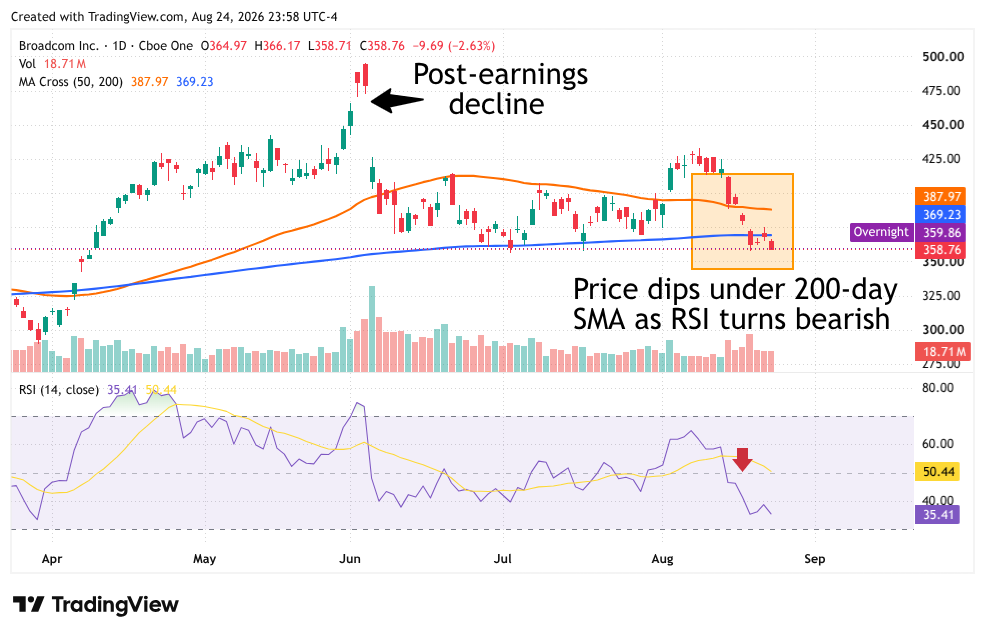
Broadcom reports its own Q3 2026 earnings on Sept. 2, but the chart is looking ugly heading into that release. The post-earnings low from June 3 has been taken out, leaving AVGO shares up just over 3% on the year. The price now trades below the 50-day and 200-day moving averages, and the RSI has fallen into bearish territory under 50.
Micron: Least Sensitive to NVDA Guidance But Tightest Link to Rubin
Micron’s numbers are arguably the least exposed to a weak NVDA guide because so much of its capacity is already claimed. In its fiscal Q3 2026 report on June 24, MU smashed top- and bottom-line expectations with year-over-year (YOY) revenue growth of 345%. Demand for high-bandwidth memory is so strong that management expects supply constraints to persist throughout the 2027 calendar year, insulating MU from weak or inline NVDA guidance.
But the company’s HBM4 units fit directly into the Vera Rubin platform racks, and it has already shipped $1 billion worth of memory. Micron’s backlog extends into 2028, so the NVDA print will give investors more hints on HBM4 pricing power than on total volumes. Micron’s gross margins in Q3 2026 already exceeded 84%, and the company is expanding fabs in the U.S., Taiwan, Singapore, and Japan.
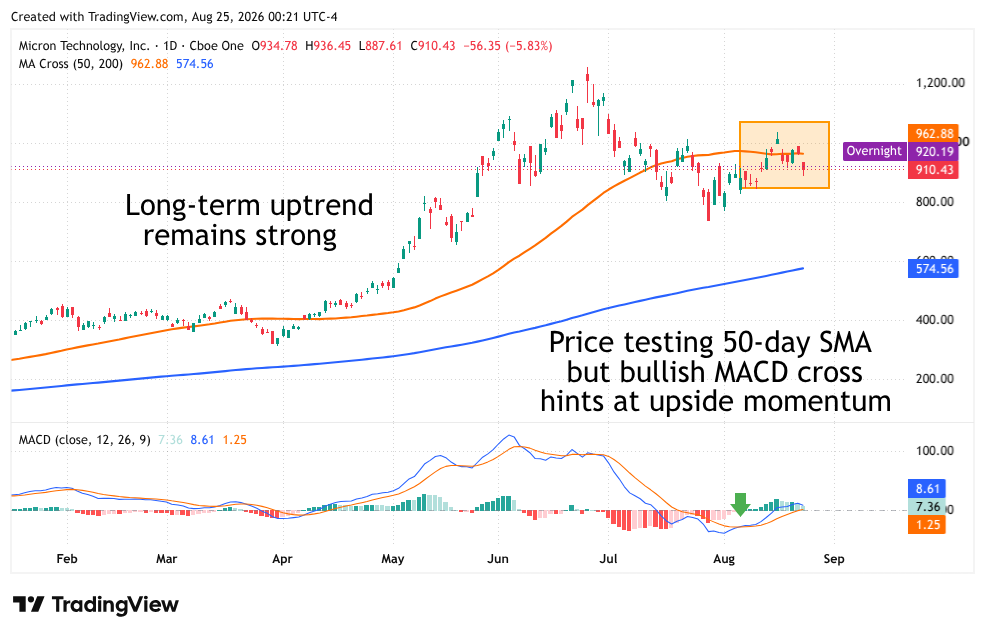
MU doesn’t report its fiscal Q4 2026 results until Sept. 24, so investors will have to wait a few weeks after the NVDA report to see where MU guides its margins. But shares are up more than 200% YTD, making it one of the best performers in the AI trade in 2026. The uptrend remains strong despite a few months of shaky trading, and the MACD suggests bullish momentum is growing again.
Further Reading
- Wiring the AI Boom: Rumble's $13.7B Pivot
- This under $1 stock could become Musk's next supplier (From Brownstone Research)
- StoneX: Too Far Too Fast?
- Why Musk's AI Plans May Hinge on One Overlooked Metal Supplier (From Brownstone Research)
- DICK's Sporting Goods Faces Pain Now for a Bigger Prize
- IBM Just Opened Its Mainframes to Arm—Is the Market Missing the Shift?
- Berkshire Boosts Its Bet: This AI Hyperscaler Is Now a Top-3 Holding

Stay Ahead of the Market
The best investment opportunities don't wait. Get our research and stock ideas delivered straight to your smartphone—so you never miss a market-moving opportunity. Our text alerts ensure you see timely stock ideas and professional research reports instantly, whether you're in a meeting, commuting, or away from your desk.


